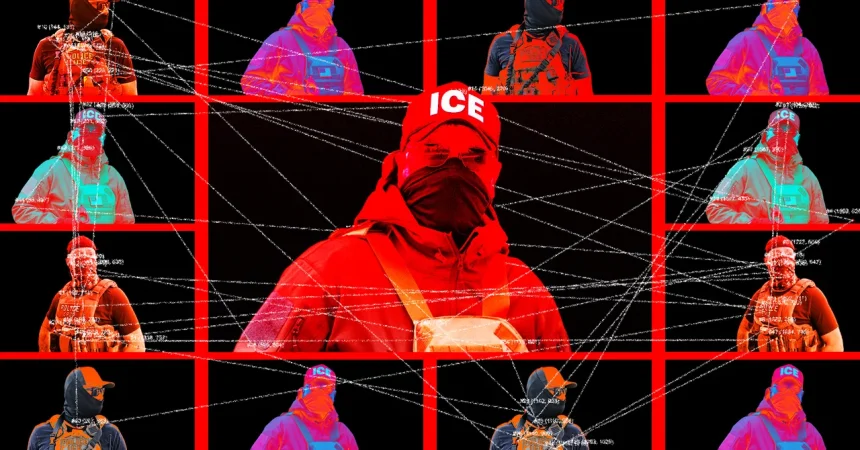
It is one thing to know, in the abstract, that the Department of Homeland Security is a vast and powerful apparatus. It is another thing entirely to see the names of real people scattered across spreadsheets that lay bare the inner workings of federal immigration enforcement, surveillance, and undercover operations. That is what happened when a trove of leaked records made its way to WIRED, offering a rare, unfiltered glimpse into how DHS actually functions behind closed doors. The agency, along with the Department of Justice, did not respond to requests for comment, and the FBI punted questions back to DHS, but the documents themselves speak volumes. They are not just a bureaucratic inventory; they are a map of the human machinery of modern federal power. For every name listed, there is a life, a career, a set of responsibilities that involve accessing some of the most sensitive systems in the country. The leak reveals, in stark and human terms, who gets to see what, who is trusted to operate the tools of surveillance and arrest, and how the department’s sprawling mission—from border policing to cybersecurity to immigration adjudication—is distributed across thousands of individual employees, contractors, and political appointees.
According to WIRED’s analysis of the data, the scale of this exposure is staggering, and it begins with Customs and Border Protection. CBP workers account for more than half of all the records in the leak, which makes sense given how many agents and officers the agency employs, but it is still sobering to see it quantified. These are the men and women at the border, the ones who check passports, search vehicles, patrol the Rio Grande, and process migrants. They are the most visible face of DHS, and now their digital identities are part of an exposed ledger of access. Immigration and Customs Enforcement follows with about 10,000 records, and roughly a third of those belong to Homeland Security Investigations, the agency’s investigative arm that pursues everything from drug trafficking to child exploitation to financial crimes. Another 6,200 records belong to US Citizenship and Immigration Services, the agency responsible for visas and green cards, and nearly 1,000 are tied to the Cybersecurity and Infrastructure Security Agency, with more than half of those being contractors who work alongside federal employees. Altogether, the files cover about a seventh of DHS’s workforce, meaning that the leak is not a small sampling but a substantial cross-section of the entire department, from senior leadership down to individual immigration agents and detention contractors. It reveals how DHS is structured in practice, not just on paper, and it makes the abstract bureaucracy feel painfully concrete.
Perhaps the most disturbing revelations come from the names of the permission groups that appear in the data. Like most large organizations, DHS uses permission groups to control access to its internal systems, but in a law enforcement agency, these groups are not just about managing IT privileges. They are about who is allowed to go deep undercover, who can listen to wiretaps, and who can engage in surveillance that most Americans never know exists. At Homeland Security Investigations, 39 employees across more than a dozen field offices belong to groups whose names include “CUC,” which federal court filings identify as “certified undercover operation.” That means these are the agents trained and authorized to infiltrate criminal organizations, to pretend to be someone they are not, and to gather evidence from the inside. Another group, apparently based in HSI’s St. Paul, Minnesota area of operations, references “Keyhole,” which court filings describe as a certified undercover operation that recently funded HSI’s undercover surveillance of Minneapolis protest groups earlier this year. This is the kind of information that rarely surfaces in public discourse, but here it is, embedded in an access list, connecting a specific group of agents to a specific, controversial surveillance effort. There are also references to a “Communications Intercept Center TechOps (CICTO) Program,” a “Title III Intercept Program” for wiretaps, and an “Illicit Sensor Intercept Program (ISIP).” These names may sound like bureaucratic jargon, but they are the labels for some of the most intrusive powers the government possesses.
The scope of the surveillance apparatus revealed in the data extends far beyond the groups themselves. There are over 55,000 permission groups in all, and their names appear to reference tools for accessing immigration court records, pulling data from seized phones, and conducting surveillance. One of those tools is Palantir’s Falcon investigative platform, a powerful data analysis system used by law enforcement to connect the dots between people, places, and events. Another is PenLink, which analyzes phone records and social media to build a picture of a suspect’s network and movements. These are not hypothetical, far-off technologies; they are in active use by DHS employees whose names now appear on a leaked list. For the average person, this may be hard to visualize, but imagine being a federal agent sitting at a desk, logging into a portal that lets you see someone’s call history, their social media posts, their location data, and their immigration records all in one place. That is the power that these permission groups unlock, and the leak shows exactly who has it. It is a reminder that the tools of modern law enforcement are not just handcuffs and sirens; they are databases, algorithms, and intercept programs that operate quietly in the background, often without public scrutiny or debate. The sheer number of groups—more than 55,000—suggests that DHS has layered its access controls in incredibly complex ways, with different combinations of permissions for different roles, regions, and operations.
But the leak also exposes something that is perhaps even more striking in its intimacy: the two permission groups named “Executive Leadership” and “AI Access” appear to list people who were given exceptions to DHS’s web filter, which blocks certain websites from employees’ work computers. These two groups contain the same 13 people, a tiny circle of high-level officials and political appointees who are trusted enough—or powerful enough—to bypass the restrictions that apply to the rest of the workforce. Among them is Kristi Noem, the former DHS head and current Secretary of Homeland Security, whose name at the top of the list signals her ultimate authority over the department. There is Antoine McCord, the recently departed DHS chief information officer who has returned to defense tech company Anduril, the same company known for its work in autonomous weapons and military technology. There is Philip Hegseth, listed as a senior advisor to the DHS secretary and the younger brother of defense secretary Pete Hegseth, which raises obvious questions about the revolving door between political appointments and family connections. And there is Jayce Krachenfels, listed as a policy adviser, who previously worked as a regional field director for Donald Trump’s 2024 presidential campaign, according to his LinkedIn profile. To see these names together is to see the intersection of politics, technology, and law enforcement in its rawest form. These are not career civil servants quietly doing their jobs; they are political operatives and appointees who have been granted special access and exemptions. It is a glimpse of how power is exercised at the top of DHS, and it raises uncomfortable questions about whether that power is being used for the public good or for political purposes.
In the end, this leak is more than just a data dump; it is a human document. It tells the story of a department that is simultaneously essential and deeply troubling. DHS employees work hard, often thankless jobs, protecting the country from genuine threats, processing millions of travelers, and responding to cyberattacks. But the systems they use are also capable of being misused, and the people who control those systems are not always neutral actors. The names in the leaked records are not just entries in a spreadsheet; they are individuals with families, careers, and moral obligations. Some are doing their best to uphold the law in difficult circumstances. Others may be using their positions to advance political agendas. The leak does not answer every question, but it forces the public to confront the reality that the machinery of federal law enforcement is run by human beings with all their imperfections. It also highlights the urgent need for oversight and transparency, because if a leak like this can expose the access lists for undercover operations, wiretaps, and executive web filter exemptions, then it is clear that the system of checks and balances is not as strong as it should be. Ultimately, the story here is not just about DHS, or the thousands of names in a database, but about what kind of country we want to live in—one where surveillance is secret and accountability is rare, or one where the people who hold the keys to power are answerable to the rest of us.