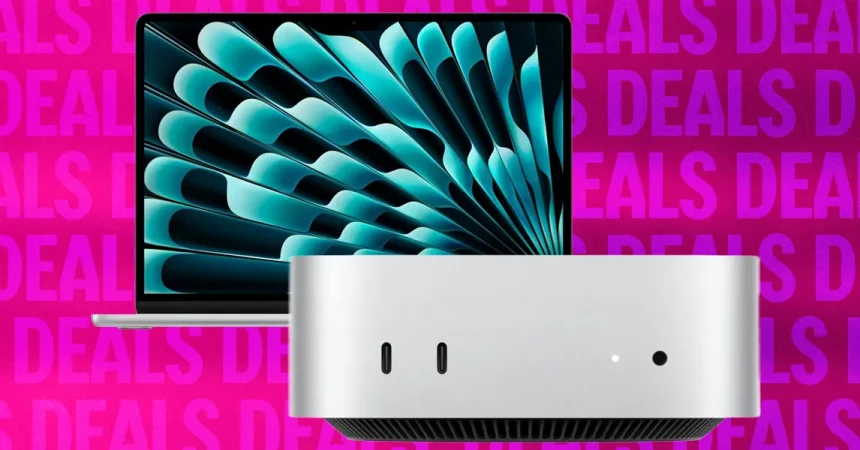
Let’s be honest: Apple’s pricing has a way of making you stop and think, sometimes in ways that feel a little absurd. Right now, there’s a deal that perfectly captures that feeling. The M6 Mac Mini is on sale for $779, which is $120 off its regular retail price. At the same time, the 13-inch M5 MacBook Air is also discounted, coming in at $150 off. Add those two together, and you’re looking at a combined price that equals what you’d pay for a single M6 MacBook Pro. That’s kind of insane when you actually sit down and think about it. You could walk away with two full computers—one that stays on your desk and one that travels with you—for the same money as one premium laptop. It’s the kind of math that makes you question whether the “best” Mac is really the best choice for most people, or whether Apple’s lineup has quietly become a collection of smarter, more flexible options that just happen to be hiding in plain sight.
Of course, there are trade-offs, and it’s important to be honest about them. The M6 MacBook Pro has some genuinely fantastic features that you won’t get from a Mac Mini or a MacBook Air. The Mini-LED display is stunning, with deep blacks, bright highlights, and the kind of contrast that makes movies and photos feel alive. The speakers are also in a different league—rich, full, and surprisingly loud for a laptop. If you’re a creative professional who needs accurate color, or someone who just loves watching content in the best possible quality, those things matter. But here’s the thing: not everyone needs that level of display and audio fidelity. For a lot of people, the MacBook Air’s screen is perfectly fine, and the Mac Mini can be connected to whatever monitor you already own or can afford. If you’re mostly writing, browsing, coding, answering emails, or doing light creative work, the difference between a Mini-LED display and a good standard display is not going to change your life. And if you’re using headphones most of the time, the speaker gap shrinks even further. So while you’re giving up some polish, you’re gaining something arguably more valuable: flexibility. You get a desktop that stays put, hooked up to a big monitor, and a lightweight laptop that you can throw in a bag and take anywhere. That combination covers more ground than a single Pro laptop ever could, especially if your daily routine involves both a home office and a coffee shop.
The argument gets even more compelling when you think about how people are actually using Macs these days, particularly the Mac Mini. There’s been a quiet shift in the way many tech enthusiasts and professionals think about their computers. Instead of treating every device as a self-contained workstation, they’re setting up always-on machines that handle heavy lifting in the background. The Mac Mini is perfect for this. It’s small, quiet, energy-efficient, and powerful enough to run serious workloads without breaking a sweat. More and more, people are using Mac Minis as dedicated AI agent boxes—machines that stay running all day and night, ready to process data, run local language models, automate tasks, or handle whatever else needs continuous compute. You don’t need a screen attached to it, or even a keyboard and mouse. You just set it up, connect it to your network, and then control it remotely from any other device. That’s where the MacBook Air comes in. You can sit on your couch with an older MacBook, or even a cheap one, and use it as a thin client to interact with your Mac Mini’s power. But pairing the M6 Mac Mini with the M5 MacBook Air takes that idea to the next level. You get a modern, portable laptop for everyday use, plus a desktop that can be configured with up to 32 or 64 gigabytes of memory, making it a serious machine for AI workloads, software development, or running multiple virtual machines. It’s a recipe for AI goodness, honestly. You have the portability to work anywhere, and the raw power to do heavy lifting at home, all without spending MacBook Pro money.
But wait, there’s another alternative that deserves attention. If you really want a MacBook Pro, you don’t have to buy the M6 model. The M5 MacBook Pro with the M5 Pro chip is available for only $200 more than the base M6 MacBook Pro. On the outside, it looks identical. Same design, same display, same keyboard, same trackpad. You’d be hard-pressed to tell them apart sitting side by side. But on the inside, the M5 Pro chip offers better performance in many tasks, especially those that benefit from additional GPU cores and memory bandwidth. That’s a pretty interesting proposition. You’re essentially paying a small premium to get a machine that’s faster in real-world scenarios, while skipping the newest generation’s initial price tag. For someone who needs the MacBook Pro experience—the display, the speakers, the build quality, the battery life—this might be the smarter buy. It’s a reminder that “newest” doesn’t always mean “best for you.” Sometimes, the previous generation is the sweet spot, especially when it’s sitting on a shelf at a discount. And if you’re worried about missing out on the M6’s improvements, it’s worth remembering that Apple’s chips have become so good that the differences between generations are often marginal for everyday users. Unless you’re pushing the absolute limits of performance, the M5 Pro will likely handle everything you throw at it with ease.
That said, I’m still genuinely interested to see how the new M6 MacBook Pro performs. Apple’s silicon has been on an impressive trajectory, and each new generation brings refinements in efficiency, graphics, and machine learning capabilities. There’s a good chance the M6 will be a fantastic machine, and for certain users—video editors, 3D artists, researchers, developers working with massive codebases—it could be worth every penny. But the price alone makes me wonder if there aren’t better ways of spending your money, even if you want to stay entirely within the Mac ecosystem. Apple’s lineup is no longer a simple ladder where you climb from Air to Pro and stop at the top. It’s more like a toolbox, and the right tool depends on the job. For $2,000, you have options that would have seemed unbelievable a few years ago. You can get a powerful desktop and a great laptop. You can get a previous-generation Pro laptop that’s still more than enough for most people. Or you can get the shiny new thing and hope it lives up to the hype. The fact that the choice is so difficult is a good thing, but it also means you should think carefully about what you actually need, not just what Apple’s marketing tells you to want.
In the end, the decision comes down to how you work and what you value. If you’re someone who lives on a laptop, moves between meetings, and needs the best display and speakers in a portable form, the M6 MacBook Pro might be the right call. But if you’re like many of us—someone who spends a lot of time at a desk, but also wants the freedom to work from a café or a couch—the Mac Mini and MacBook Air combo is incredibly tempting. It’s hard to argue with two machines for the price of one, especially when both are modern, capable, and ready to handle whatever you throw at them. And with the rise of AI agents, background processing, and remote work, having a dedicated always-on Mac Mini is becoming less of a niche setup and more of a smart, practical investment. You get the best of both worlds: a powerful desktop that works for you around the clock, and a light, portable laptop that’s a joy to carry. So before you drop two grand on a single MacBook Pro, take a moment to consider the alternatives. Maybe the future isn’t one perfect device. Maybe it’s a pair of good devices that fit together perfectly. Your wallet might thank you, and honestly, your workflow might thank you too.