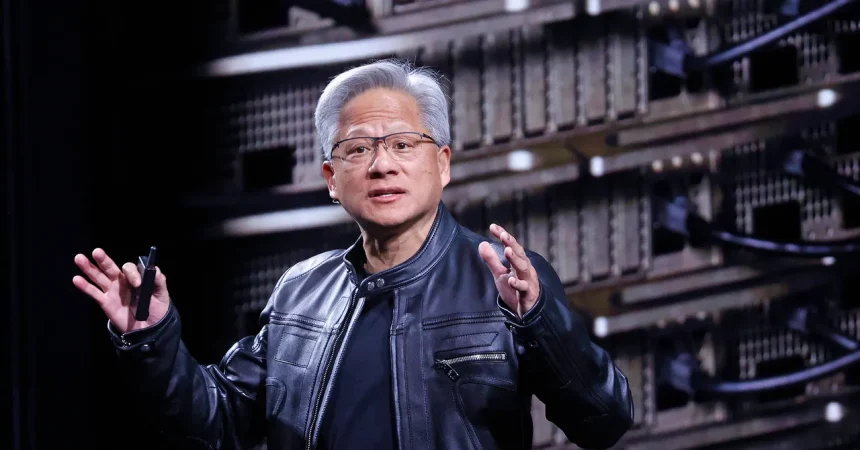
1. The rise of Jensen Huang has been one of the defining stories of the artificial intelligence boom, a tale of astonishing foresight, relentless execution, and almost unimaginable personal fortune. For years, he has been more than just the chief executive of Nvidia; he has been the human face of the AI revolution, the man who turned a computer graphics company into the most important hardware supplier on Earth. As the demand for AI chips exploded, Huang’s wealth soared, his public profile grew, and his influence reached into the highest corridors of power. He became a close confidant of President Donald Trump, a prominent voice in the delicate and often tense relationship between the United States and China, and the ultimate arbiter of who gets access to the scarce, precious chips that power the world’s most advanced artificial intelligence systems. To many, he seemed untouchable, a visionary whose instincts had been proven right time and again. But in the last few days, that carefully constructed edifice of power has suddenly looked fragile. Huang has admitted to an affair with Alice Huang, an executive at a Singapore-based company whom US intelligence services concluded was a Chinese intelligence asset. The admission has shattered the narrative of invincibility, forcing Nvidia’s board to launch an investigation and throwing the future of the company’s leadership into sudden, unsettling doubt. The man who seemed to hold the entire AI industry in his hands now finds himself fighting to protect his own position, and the outcome of this scandal could reshape not just Nvidia, but the broader technological landscape that depends on it.
2. The details of the affair and the ensuing corporate response are still emerging, but the stakes could not be higher for Huang personally and professionally. Nvidia’s board of directors has announced that it will launch a formal investigation into the incident, and the company has stated that Huang “fully supports the review and has committed to cooperating with it.” That statement, while seemingly routine, carries enormous weight in a company where Huang has long been the undisputed center of gravity. According to a corporate filing, Huang earned $36 million last year and owns about 3.5 percent of Nvidia as of March, a stake worth tens of billions of dollars. Yet the same filing revealed a stark vulnerability: Huang is an at-will employee, meaning he can be let go at any time without severance. This is a remarkable position for a founder-CEO who has become synonymous with his company, and it underscores just how precarious his situation has become. The board’s investigation will likely focus on whether Huang violated any company policies, including codes of conduct or disclosure requirements. But the implications go far beyond internal corporate governance. The fact that the affair involved a woman identified by US intelligence as a Chinese asset raises serious national security questions. If Huang shared sensitive information with her, knowingly or unknowingly, the consequences could be catastrophic. Even if he did not, the appearance of impropriety is enough to damage his credibility, especially in an industry where trust and loyalty are paramount. Huang has built his career on being the smartest person in the room, the one who always had an answer, but now he faces questions that no amount of technical brilliance can resolve.
3. To understand why this scandal matters so much, one must understand the extraordinary power that Huang wields in the AI ecosystem. Nvidia, which Huang cofounded in 1993, controls roughly 90 percent of the market for the chips used to train frontier AI models. These chips are not just a commodity; they are the engine of the entire artificial intelligence boom. Every major AI company, from OpenAI to Anthropic to Google, depends on Nvidia’s hardware to build and run their models. With supply limited and demand insatiable, Huang has effectively become the gatekeeper of the AI revolution. As David Yoffie, a professor at Harvard Business School who tracks the chip industry, put it: “He’s the person who decides who gets the chips and who doesn’t.” This is not an exaggeration. When Elon Musk wants to build a new data center, he can put in a call to Huang. When a startup needs access to cutting-edge processors, it must find a way to get on Nvidia’s good side. Huang’s influence extends even further, as Nvidia has invested billions of dollars in the very companies that buy its chips, including OpenAI and Anthropic, creating a web of financial and technological interdependence that is almost unprecedented in corporate history. This means that Huang’s personal judgment, his preferences, his grudges, and his loyalties have a direct impact on the direction of the entire industry. A decision made in his office can determine whether a promising AI startup thrives or dies, whether a particular research direction gets the computational resources it needs, and whether the United States maintains its lead over China in the race for artificial intelligence. The idea that this man might be compromised, distracted, or forced out of power is deeply unsettling to an industry that has built its entire future around him.
4. Huang’s management style has only intensified the sense that Nvidia is inseparable from its founder. Current and former employees describe a leader who is deeply involved in even the smallest details of the company, a man who personally responds to emails from any of Nvidia’s roughly 60,000 staff members and who is not afraid to raise his voice to make a point. He is a regular presence on cable television and at tech conferences, where he has worked tirelessly to deflate concerns about an AI market bubble and to position Nvidia as the indispensable infrastructure of the future. This hands-on approach has been a key factor in Nvidia’s success, allowing Huang to maintain a level of control and coherence that is rare in a company of this size. But it also means that there is no obvious successor waiting in the wings. Nvidia has no other executive anywhere close to Huang’s prominence, and no apparent candidate who could step into his shoes without a significant transition period. Yoffie captured this anxiety perfectly when he said, “We have no idea who would replace him. You put someone new into that position, if you’re a customer, who knows what that’s going to mean.” This is a terrifying prospect for Nvidia’s customers, partners, and investors. The company’s value is not just in its technology, but in the vision and judgment of its founder. Huang has been the one who charted the course, who made the bold bets on GPU computing, who convinced the world that AI would transform everything. Without him at the helm, there is no guarantee that Nvidia would continue to make the same kind of daring, forward-looking decisions. The company might become more cautious, more bureaucratic, or simply less innovative. In an industry that moves at breakneck speed, that could be a fatal flaw.
5. The national security dimension of this scandal adds another layer of complexity and danger. Ryan Fedasiuk, a senior fellow at the think tank Foundation for American Innovation, has argued that Huang has become “load-bearing” for the entire US AI industry. He is not just a CEO; he is a strategic asset in the geopolitical competition with China. Huang has played a crucial role in shaping US policy on chip exports, and his close relationship with President Trump has given him direct access to the highest levels of government. This makes the affair with Alice Huang all the more alarming. US intelligence services concluded that she was a Chinese intelligence asset, which means that any information she obtained from Huang could have been passed to the Chinese government. The FBI could investigate whether any laws were broken, particularly those related to espionage or the transfer of sensitive technology. Congress may also decide to look into whether Huang’s affair influenced the US government’s policy on selling chips to China. Fedasiuk’s comments highlight the paradox at the heart of Huang’s situation: “On the one hand, Huang is irreplaceable. He built Nvidia into the juggernaut it is today, and he was the visionary behind the GPU, which has sustained the intelligence revolution.” But he also acknowledges that the company, which is indispensable to the AI industry, has to come first. “He has to be replaceable as the CEO of the world’s largest company, at $4 trillion in capex.” This is the cruel irony of Huang’s position. He is so important that the industry cannot afford to lose him, but he is also so important that the industry cannot afford to keep him if he poses a security risk. The investigation will have to navigate this impossible tension, balancing the need for accountability with the need for stability. Whatever the outcome, the trust that once seemed so absolute has been broken, and it is hard to imagine that it can be fully restored.
6. The market has already begun to react to the uncertainty, with Nvidia shares falling more than 4 percent on Monday even as broader stock market indices rose. This drop reflects the deep anxiety that investors feel about the possibility of Huang’s departure, whether through resignation, termination, or some other consequence of the investigation. It is a reminder that Nvidia’s value is not just in its chips, but in the confidence that the market has in its leader. For years, Huang has been the ultimate symbol of the AI boom, the man who turned a graphics card company into a $4 trillion behemoth. His personal story, from immigrant to tech titan, has been an inspiration to many. But now that story has taken a darker turn, and the world is watching to see how it ends. The investigation will take time, and the truth may be complicated and messy. It is possible that Huang will survive this scandal, that the board will find no wrongdoing, and that he will continue to lead Nvidia for years to come. It is also possible that this is the beginning of the end, that the affair will prove to be the fatal blow to a career that seemed destined to end only on his own terms. What is certain is that the AI industry, and the world that depends on it, will be watching with bated breath. The fate of Jensen Huang is now intertwined with the fate of the technology he helped create, and the outcome of this personal and corporate drama will shape the future of artificial intelligence for years to come. In the end, this is a story about power, trust, and the fragile line between personal judgment and public responsibility. It is a reminder that even the most powerful people in the world are not immune to the consequences of their choices, and that the same qualities that make a great leader can also make a great fall.