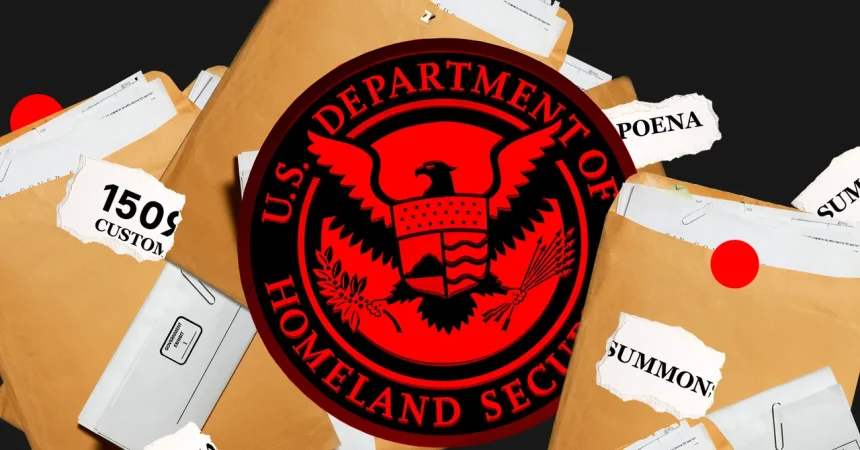
There is a kind of investigation that happens without sirens, without a knock on the door, and at first without anyone ever knowing. It lives in the administrative machinery of the federal government, in documents that ask companies for records and in databases that quietly fill with names. Homeland Security Investigations, the investigative arm of Immigration and Customs Enforcement that usually focuses on transnational crime, has been using this kind of power with extraordinary intensity. According to a recent court filing, HSI estimates that it has sent out at least 185,000 administrative subpoenas since the start of the Trump administration. The number is hard to wrap one’s mind around, because it represents a scale of legal coercion that did not exist before. A previous WIRED analysis found that over a stretch of roughly six and a half years, from the beginning of 2016 to mid-August 2022, ICE agents sent out only about 170,000 of a particular kind of administrative subpoena known as a 1509 customs summons. In other words, what took more than six years to accumulate may now have been matched or surpassed in a far shorter period of time. The statistic should not be read as just a footnote to a lawsuit. It is a signal that the federal government has crossed into a new, more aggressive mode of inquiry, one that can touch the lives of ordinary people who have never committed a crime, never crossed a border illegally, and never even drawn the attention of a police officer until their name appeared in a record produced by an administrative demand.
The disclosure came out of a Freedom of Information Act lawsuit filed by the Electronic Frontier Foundation against the Department of Homeland Security. The EFF had requested information about how many administrative subpoenas DHS or ICE sent to technology companies, internet platforms, and service providers since January 20, 2025. The court filing revealed the 185,000 estimate, but as Aaron Mackey, the EFF’s deputy legal director, has noted, it is not yet clear whether that count includes only subpoenas directed at tech companies and online platforms or whether the figure covers a much larger set of targets. That ambiguity matters, because the difference between a narrow surveillance program and a sprawling dragnet is precisely the kinds of organizations being asked to turn over records. To understand why the number is so alarming, it helps to understand how administrative subpoenas differ from other legal demands. When a grand jury subpoena or a court order is used, the government generally has to justify its request to a judge, explain why the documents are relevant, and operate within a framework of rules that is at least somewhat visible to the public. An administrative subpoena is a different creature entirely. It is a demand for records issued by an agency under its own authority, without the need to seek permission from a judge first. There is no probable cause requirement, no neutral magistrate reviewing the request, no public docket where the target or the public can examine what is being demanded and why. In practice, this means the government can ask a company to hand over customer records, financial transactions, messages, or location data based on its own internal reasoning, and the company is often left with little choice but to comply. The subpoena is, for all practical purposes, a self-issued warrant, and the fastest way to understand its power is to imagine what it would feel like to receive one unexpectedly.
The human consequences of this authority are not hypothetical. Since the start of the Trump administration, federal agencies have used DHS’s administrative subpoena power to try to unmask anonymous online critics and to chase down customer records related to protest activity. One example that has come to light involves a green beanie. During the unrest following the police killing of George Floyd, federal investigators sought a list of people in the Minneapolis-Saint Paul area who had purchased a particular green beanie from REI. The demand appears to have been aimed at identifying someone who posted critical comments online or to connect a particular item of clothing to a broader protest investigation. But the request swept in everyone who had bought that hat, ordinary people who simply saw something they liked and purchased it, never imagining that their harmless consumer behavior would end up in a federal case file. The beanie example stands out because it is so easy to picture: a person, a purchase, a paper trail. It shows how administrative subpoenas can be used to obtain names, addresses, IP addresses, payment histories, and other intimate details of daily life. And it is chilling precisely because the targets are not necessarily suspected of any serious wrongdoing. They are people who bought the wrong thing, at the wrong time, in the wrong place. The chilling effect extends beyond the individuals directly caught up in such requests. When people learn that the government can demand their private records without a judge’s sign-off, they become more careful, more guarded, more afraid. They may think twice before posting a comment, before showing up at a rally, before making a purchase that could be misread as a political statement. That is not just a side effect. It is the way that unchecked investigative power works on the human spirit.
The story of the 1509 customs summons is a story about how a narrow and practical tool can be transformed into a general-purpose weapon. Congress originally gave this power to the then-standalone US Customs Service nearly a century ago, with a modest aim in mind: customs officers needed a way to inspect business records related to imported merchandise so they could determine whether importer owed customs duties. In that original context, the summons had a clear and limited purpose. It was about cargo manifests, invoices, and the mechanics of trade. The idea was not to give the government a broad license to collect information about ordinary citizens; the idea was to make sure that imported goods were properly documented and taxed. But in 2003, Congress transferred the Customs Service’s powers, including the authority to issue 1509 customs summons, to the newly formed Department of Homeland Security. With that move, the summons came to live inside a much larger apparatus, one whose mission included counterterrorism, immigration enforcement, border security, trafficking, and the broad investigation of transnational crime. The old limitations, the ones that made the power sensible when applied to shipping records, did not survive the transfer intact. What had been a specialized mechanism for looking at import-related paperwork gradually became a general investigative utility. Over time, it has been used to obtain records from technology companies, financial institutions, retailers, and other businesses that have no connection to importing anything at all. The form is the same, but the substance has changed completely. The legal framework that was designed for one era has been stretched to fit another, and the stretch did not happen through a public debate or a thoughtful act of Congress. It happened through accumulated practice, one subpoena at a time, mostly out of sight.
At one point, there were at least some guardrails. In 2017, the inspector general for the Department of Homeland Security admonished Customs and Border Protection’s Office of Professional Responsibility for trying to use a customs summons to unmask an anonymous Twitter poster. The inspector general noted that the agency’s own procedures manual said the summons could only be used to obtain information related to customs or immigration laws. That admonishment was an attempt to hold the agency to its own rules, to prevent the erosion of a legal safeguard that distinguished between a legitimate customs or immigration purpose and an excuse for general surveillance. The fact that such an admonishment was necessary in the first place shows how easy it is for agencies to drift beyond their authorized boundaries. But the current estimate of 185,000 administrative subpoenas suggests that the drift has become something more like a sprint. Either the government has decided that its authority to issue these subpoenas can cover almost any investigation, no matter how far removed from customs or immigration, or it has simply stopped paying attention to what the law requires. From the outside, the public cannot tell the difference. There is no way to know how many of those subpoenas were related to a plausible customs purpose, how many were connected to immigration enforcement, and how many were directed at ordinary internet users, protesters, or customers of a small online store. The EFF’s lawsuit is, in part, an attempt to find out. But it should not take a lawsuit to force a basic level of transparency from an agency that has been given extraordinary power. The secrecy surrounding administrative subpoenas is perhaps their most dangerous feature. Without transparency, there can be no oversight. Without oversight, there can be no accountability. And without accountability, the very idea that the government is bound by law becomes more of an aspiration than a fact.
What makes this all so unsettling is not simply that federal agents have access to powerful investigative tools. It is that those tools are increasingly turned on ordinary people, often without their knowledge, for reasons that have little to do with the original purpose of the law. Whether the true number is 185,000 or something slightly different, the scale of issuance points to a system in which administrative subpoenas have become a first resort, not a last resort. They are cheap, easy, and convenient, at least for the government. But for the people caught in their path, they can be invasive and frightening. A person can go about their life, buy a hat, post a thought, attend a demonstration, and never learn that someone in Washington has pulled together a file with their name on it. The government has bypassed the courts, skipped the safeguards, and quietly built a shadow surveillance system using paperwork that most people have never heard of. The history of the 1509 customs summons—from a narrow tool for customs duties to a sweeping instrument of investigation—is a warning about how power creeps outward when nobody is watching. This is not an argument against all law enforcement, and it is not a claim that every administrative subpoena is malicious. It is a claim that power without boundaries is dangerous for everyone, including the officers and agents who are supposed to serve the public. A democratic society cannot survive on trust alone. It needs rules, oversight, and the willingness to ask hard questions, even when those questions are inconvenient. The administrative subpoena was never intended to be a blank check. It was meant to serve a specific purpose, in a specific context, under specific limitations. Those limitations have been eroded, and the public deserves to know exactly how much of that erosion has happened after January 20, 2025. The EFF is trying to get that answer. The rest of us should be asking for it too, not because we assume the worst, but because in a free country, the burden should always be on the government to explain why it needs so much power and to show that it can be trusted with the breathtaking amount of personal information it has already collected.