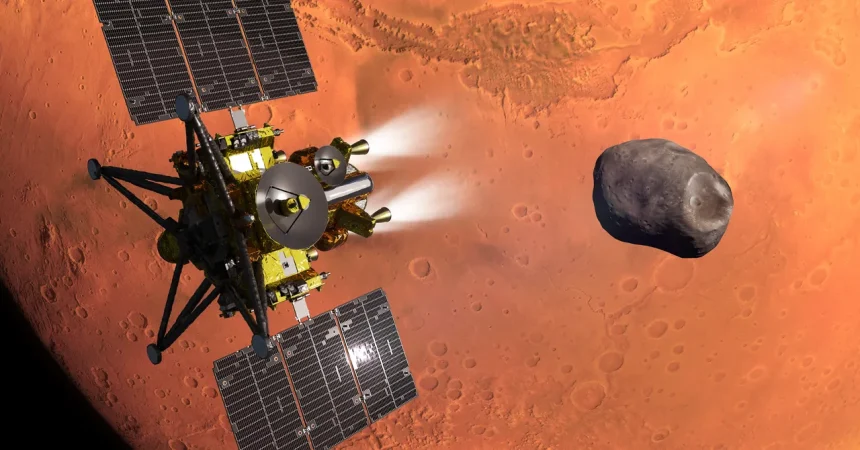
Imagine standing on a launch pad in the middle of the night, looking up at a spacecraft that is about to embark on a journey most people would call impossible. The destination is a gray, dusty, potato-shaped moon orbiting Mars, and its name is Phobos—after the Greek god of fear. The name is not an exaggeration. Every previous attempt to reach that moon has ended in failure. Since the 1980s, Russia has sent three separate probes to Phobos, and all three have met the same fate. The first two, Phobos 1 and Phobos 2, were launched in 1988; Phobos 1 went silent en route, while Phobos 2 somehow managed to reach Mars orbit and send back a few images before losing contact during the final approach to the moon. The last attempt, in 2011, was named Phobos-Grunt, and it died in low Earth orbit before its engines could even send it on the interplanetary path. It was a spectacular and painful failure, and it reinforced the moon’s reputation as a place where robotic ambitions go to disappear. And yet, when Japan’s space agency JAXA and its international team of scientists talk about the next mission to Phobos, the mood is not one of dread. Kiyoshi Kuramoto, the mission’s lead scientist, says all of the members are filled with a quiet sense of excitement. The mission is called the Martian Moons eXploration, or MMX, and it is scheduled to launch from Japan’s Tanegashima Space Center in the wee hours of Tuesday morning, Japan time—Monday afternoon in the United States. After nearly a year of traveling through the dark, it will reach Mars and begin an unprecedented investigation of the two tiny moons clinging to the planet. And at the heart of the mission is a question that has haunted planetary scientists for years: how were Phobos and Deimos born?
Phobos and Deimos are not big, glamorous worlds. Phobos is only about twenty-two kilometers across, a lumpy, densely cratered rock that resembles a giant potato. Deimos is even smaller and farther out, with a smoother surface and an even more mysterious past. Their names come from Greek mythology: Phobos, meaning fear, and Deimos, meaning dread, twin sons of Ares, the war god whom the Romans knew as Mars. The names somehow seem appropriate for two strange objects that patrol the outer edges of the Red Planet, constantly stirring astronomers’ dreams. But despite their fearsome names, the moons are scientifically delicate and fascinating. MMX will approach both of them from orbit, observing their shapes, colors, surface temperatures, and gravitational fields. For the first time, scientists will be able to study the pair in intimate detail, rather than as tiny points of light or blurred smudges in telescope images. The mission’s planners intend to learn why the two moons look different from one another, how their surfaces are weathered, and how dust travels across them in the near-total absence of a substantial atmosphere. But the greatest prize lies on Phobos. After months of mapping, the spacecraft will try to descend to the moon’s surface, collect chunks of rock and dust, and lift off again. Those samples will be transferred to a return vehicle and eventually sent back to Earth, where they are due to arrive in 2031. If successful, this will be the first sample-return mission in history from a moon other than Earth’s own. The mission is not only about a weird little moon; it is about unlocking the early history of Mars, of the solar system, and of the processes that shaped all the worlds we see today.
The mystery of the moons’ origin is one of the oldest unsolved problems in planetary science. There are two main scenarios, and they lead to very different visions of the early solar system. The first is that Phobos and Deimos are captured asteroids. This idea has strong support from their appearance: they are dark, ragged, heavily cratered objects, and the light they reflect is very similar to that of primitive asteroids, especially those rich in carbon. They look exactly like the kind of small bodies that drift through the asteroid belt between Mars and Jupiter. In this scenario, Mars captured them long ago, and they have remained almost unchanged since the beginning of the solar system. The second scenario is far more violent. It imagines a young Mars barely stabilized, still recovering from the chaotic era of planet formation, when a gigantic asteroid—perhaps hundreds of kilometers across—slammed into the planet. The collision would have vaporized enormous quantities of rock, throwing molten debris and superheated dust into orbit. Over time, that cloud of material coalesced into a ring around Mars, and the ring gradually clumped together to form the two moons. This impact theory neatly explains why Phobos and Deimos follow such orderly paths. Their orbits are almost perfectly circular and aligned with Mars’s equator, exactly what you would expect from a debris disk that flattened into a settled plane around the planet. A captured asteroid, by contrast, would be much more likely to follow an eccentric, tilted orbit, like a stray object trapped on the edge of a gravity wheel. Tom Statler, MMX program executive at NASA, said at a press briefing that the mission is designed to help settle the debate. The stakes go beyond one pair of moons. Understanding whether Phobos and Deimos are captured asteroids or impact debris tells us how many minerals and volatile compounds might have been delivered to Mars—and, by extension, to Earth-like planets throughout the galaxy.
To answer the question, MMX will have to read the chemical fingerprints hidden in the surface of Phobos. That is the job of MEGANE, one of the most important instruments on the spacecraft—and a name that happens to mean “eyeglasses” in Japanese, which is a fitting description for something that can see the invisible chemical world of a moon. MEGANE is designed to measure the gamma rays and neutron particles that are constantly streaming out of Phobos’s surface. These emissions are triggered by cosmic rays from the Sun, which smash into the moon’s rocks and cause the atoms inside to release telltale radiation. By measuring the energy of those gamma rays and neutrons, the instrument can determine which chemical elements are present and in what quantities. The results should distinguish between the two origin scenarios. The captured-asteroid hypothesis predicts that Phobos should be rich in volatile elements such as hydrogen and potassium—elements that are plentiful in the cold outer solar system and easily boiled away at high temperatures. The giant-impact hypothesis, by contrast, predicts that Phobos should be depleted in these volatiles, because the enormous heat of the collision would have baked them out of the debris before the moons formed. No one knows which pattern actually exists. “We know nothing about Phobos’ elemental composition,” says David Lawrence, who leads the MEGANE team at Johns Hopkins University. “For me, that’s what’s exciting—making a measurement nobody’s done before.” The other instruments on board will also play vital roles. A high-resolution camera will map the surface, revealing boulders, craters, and layers that may preserve the moon’s history. A laser altimeter will measure the shape and terrain of Phobos in three dimensions, allowing scientists to model its internal structure. A thermal mapper will record how much heat the surface absorbs and emits, which can reveal the thickness of the dust layer. And a small rover, built as part of an international collaboration, will be released before the main spacecraft lands. The rover will explore the surface ahead of MMX, testing soil mechanics and sending back close-up images from a world no rover has ever visited.
After the reconnaissance phase, MMX will attempt one of the most delicate landings ever planned. Phobos has extremely low gravity, just a few thousandths of Earth’s. A spacecraft landing there is less like landing on a planet and more like carefully docking with a potato that happens to be floating in space. The plan calls for the main spacecraft to touch down gently on the surface, perhaps using thrusters to keep itself pressed against the ground while it operates. It will collect at least ten grams of material, which is not much by Earthly standards—a small spoonful, a pinch of dust—but enough to transform the scientific understanding of the entire system. The sampling will be accomplished in two different ways, almost like having an insurance policy. One method will scoop up loose material from the very top layer, the surface regolith that has been irradiated and altered by space weather. The other method will penetrate deeper, reaching material that may have been shielded from those effects for billions of years. The two samples could tell very different stories about how Phobos was assembled and what has happened to it since. After sampling, the spacecraft will carefully seal the material in a capsule and take off from the surface, leaving Phobos behind. The capsule will eventually make the long journey back to Earth, arriving in 2031. If it lands safely, scientists around the world will be able to study the samples with techniques far more precise than anything that can be sent on a robot. They will date the rocks, analyze their isotopes, search for organic molecules, and look for clues to the origin of the Martian moons. Abigail Fraeman, an MMX team member at NASA’s Jet Propulsion Laboratory, says that the orbital observations will give hints, but the returned samples will actually answer the big questions. It is a mission of patience, precision, and hope.
It would be foolish to pretend there is no risk. The history of Phobos is one of broken spacecraft, silent signals, and dashed hopes. The engineers at JAXA and their partners across the world know this better than anyone. They have spent years testing and retesting, refining every procedure, preparing for emergencies, and imagining all the ways a mission like this can fail. In space, even the smallest bug can become a disaster. But the human spirit does not explore by running away from fear. It explores by acknowledging the fear, respecting it, and then moving forward anyway. That is perhaps the most moving thing about MMX. It is an act of courage aimed at a place named for the god of fear, carried out by people who have studied the failures of the past and chosen to believe they can do better. The launch from Tanegashima will happen in the small hours of the night, watched by controllers in dark rooms, by families and friends, by colleagues who have spent a decade or more on the project. There will be no way to know, in that first moment of thunder and light, whether the spacecraft will make it. But it will be the beginning of a long, brave journey. On the far side of that journey lies a tiny, ancient, silent moon. For millions of years, Phobos has orbited Mars, waiting, as if it knows its secret is important. Now someone is finally coming to collect it. Whether the answer is asteroid capture or giant impact, whether the samples return or not, the attempt itself is a triumph. It says something beautiful about human nature: that we will cross hundreds of millions of kilometers of cold, black space, not for conquest or gold, but because we want to understand a place whose very name means fear—and by understanding it, take the fear away.