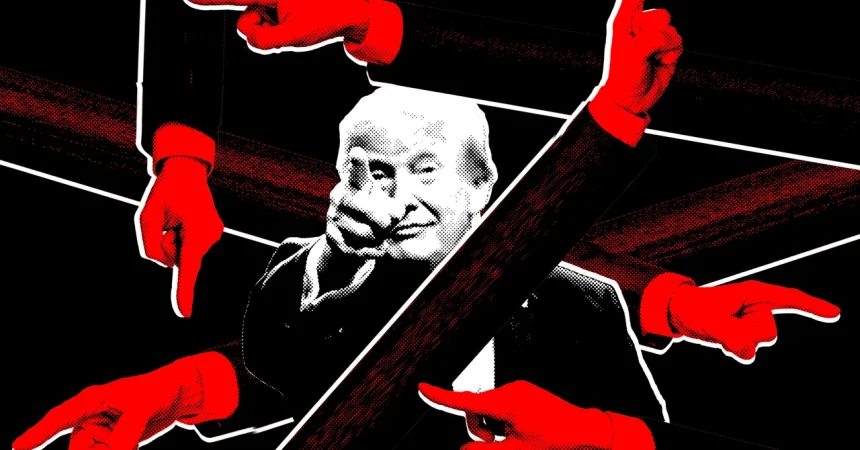
Election nights have a way of turning even the most levelheaded political professionals into amateur archaeologists of blame. They sift through polling cross-tabs, focus-group videos, and late-night text chains, searching for a single name that can be delivered to the president like a ceremonial offering. This year, the excavation has started unusually early. With Republicans staring down brutal forecasts in the House and Senate, Trump White House aides have begun to cast about for a scapegoat, sources familiar with the matter say. The public argument is about turnout, about messaging, about hostile media. The private argument is far more uncomfortable. In off-the-record conversations, Republican operatives will tell you that the real reason for the coming disaster is the president himself. “Clearly it’s the president’s fault,” one operative told Inner Loop. The decision to go to war with Iran in an election year has pushed prices higher, rattled independent voters, and produced a nationwide backlash against the party in power. That is the kind of political weather that wipes out majorities. But it is also, for obvious reasons, a conclusion that no aide can state publicly or whisper to Trump behind closed doors. The man who caused the problem is the one man who cannot be blamed. So the search is on for somebody else, and in Trump’s Washington, somebody else is always found.
The search has landed on James Blair, the deputy chief of staff and political strategist who helped build Trump’s 2024 turnout machine and then returned to run the same operation for the midterms. Blair is not a random target. He is a senior, credentialed, loyal player, the kind of person who can be offered up without too much awkwardness. The plan he championed was supposed to be a masterstroke: move early to redraw congressional maps in key states, lock in favorable lines, and create a structural firewall against the usual midterm erosion. In theory, even accounting for the drag of the Iran war, that redistricting gambit was worth roughly ten to fifteen extra Republican House seats. At first, it looked like it might work. When Virginia’s top court blocked Democrats from redrawing their own maps to keep pace in the redistricting battle, the victory felt so complete that one triumphant voice in the Republican orbit posted on X: “Lord grant me humility.” In retrospect, the prayer was a little too on the nose. Humility arrived, but not in the form anyone expected. The favorable maps that were supposed to protect vulnerable Republican incumbents have become a source of danger, because the political ground beneath them has shifted in ways that no line-drawing exercise could capture.
The backfire has been remarkable. Five months after the redistricting plan was celebrated, election forecasters have concluded that several of the newly drawn seats now favor Democrats. Florida’s 25th congressional district, just south of Fort Lauderdale, is currently characterized as “Lean Democrat.” That is not a red district anymore; it is a district where the map the GOP drew has turned against them. The Congressional Leadership Fund, the major outside group aligned with House Republicans, has already pulled its money out of the race there. When the cavalry leaves, the people back home begin to wonder whether the battle is already lost. In Texas, a state so ruby-red that Republicans normally treat it as a noncombat zone, the picture is suddenly shaky. In Texas’s 15th congressional district, GOP candidate Monica De La Cruz now finds herself in a race rated a “tossup” by the Cook Political Report. She is an incumbent, she is in a red state, and she is still struggling. That is the measure of how badly the environment has deteriorated. The redistricting plan was built to give Republicans a cushion, not a casket, but the math has flipped, and the seats that were supposed to deliver a comfortable majority are now delivering panic instead.
Blair’s allies, inside and outside the West Wing, say the criticism directed at him is grossly unfair. They argue that no political strategist could have foreseen the effects of a war with Iran, or the cascading scandals involving Trump officials that have eroded public trust and scrambled the political calendar. They describe Blair as a man who built a sturdy car and then watched someone else drive it into a ditch. The turnout model he designed was built for a world in which the economy was stable and the president’s coalition could be roused with enough energy, grievance, and repetition. That world no longer exists. A war, higher prices, and a constant drumbeat of administration chaos have changed the chemistry of the electorate. The voters who showed up in 2024 because they were furious about the previous administration are now furious about the cost of living. They are not asking which party drew the map. They are asking why their money doesn’t stretch as far as it used to. Blaming the groundskeeper for a hurricane is a Washington tradition, but it is still a strange way to run a political operation. Yet in this White House, the tradition is not just accepted; it is practically the only survival strategy.
The deeper problem is the impossible politics of blame. Trump has never accepted personal responsibility for a political setback, and his staff knows that the fastest way to lose your job is to tell him otherwise. He demands loyalty, and loyalty, in this context, means finding someone else to carry the weight. The scapegoat has to be important enough to make the sacrifice feel real, but not so important that the loss is unthinkable. James Blair fits that profile perfectly. He is a senior figure, close enough to the center of power to be credible as a decision-maker. He is also a strategist, which means every choice he made can be second-guessed after the fact. Did he move too aggressively on redistricting? Did he rely too heavily on the 2024 turnout coalition? Did he misjudge the political tolerance of suburban voters? None of these questions would be asked if the election were going well. But it is not going well, and so they will be asked again and again. If the losses are severe, Blair can be offered to the president as proof that someone has been held accountable. It is a cruel game, but it is the only game the White House knows how to play.
In the end, the scapegoat narrative says more about the Republican Party than any redistricting map ever will. A political operation that cannot tell its principal the truth is an operation that will always need a human sacrifice. James Blair may or may not survive the midterm bloodbath. What matters to the people around Trump is that someone does not. They need to walk into the Oval Office after a bad night and say, “Here is the problem, and here is the person responsible.” They need to show the president that they are still loyal, that they have identified the source of the pain, and that they can make it go away. The irony is that the plan Blair built was never the real problem. The real problem is a president whose policies have made his own party toxic, and a political culture in which saying so is considered an act of treason. The midterms will come, the losses will be enormous, and the blame will be distributed with all the precision of a political knife fight. It will land on James Blair, or someone like him. It will not land where it belongs, because in Trump’s Washington, it never does. And so the aides will keep searching, the scapegoat will be offered, and the whole cycle will begin again.