Paragraph 1: The Unsettling Revelation of a Surveillance State
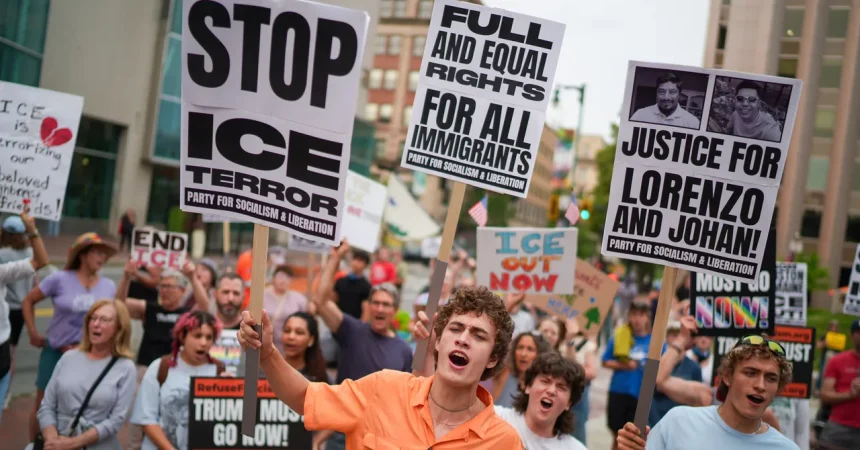
The recent unsealing of a court filing in a federal case in Maine has peeled back the curtain on a deeply unsettling reality about how the US Department of Homeland Security (DHS) may treat its own citizens who seek to exercise their constitutional right to observe government actions. The explosive allegations, which are part of a proposed class-action lawsuit, claim that DHS agents systematically built detailed dossiers on individuals who were merely watching and documenting immigration enforcement operations. These dossiers, which allegedly included photographs, license plate numbers, home addresses, and personal relationships, were not stored in a simple notebook or a local spreadsheet; rather, they were meticulously cataloged within the Investigative Case Management (ICM) database, a sophisticated surveillance and data-analysis platform built by the controversial tech company Palantir. The implications of this are staggering. It suggests that the very tools designed to track criminal suspects and national security threats were being repurposed to monitor and intimidate grandmothers, retirees, and community members who dared to hold the government accountable. The filing paints a picture of a federal agency that has conflated civic vigilance with criminality, transforming peaceful observers into labeled threats. While DHS has dismissed the case as “meritless” and denies the existence of a database of “domestic terrorists,” the documents and depositions embedded in the filing tell a far more troubling story, one that strikes at the very heart of democratic oversight and the First Amendment. The plaintiffs are not accused of any crime, nor are they alleged to have interfered with any arrest; their only transgression, according to the government’s own records, appears to be that they watched, photographed, and asked questions.
Paragraph 2: The Human Faces Behind the Legal Battle
To understand the gravity of these allegations, one must look beyond the legal jargon and see the human beings at the center of this conflict. The plaintiffs—Elinor Hilton, Colleen Fagan, Polyxenia Pantos, and Carlyn Williams—are not professional activists or radical agitators. They are ordinary citizens, likely driven by a sense of moral duty and civic responsibility, who decided to witness the actions of Immigration and Customs Enforcement (ICE) during a surge operation dubbed “Operation Catch of the Day” in Maine this past January. Their motivation was simple: to ensure that the government, particularly in the enforcement of immigration laws, acted with transparency, legality, and humanity. They stood on public sidewalks, a few car lengths away from arrests, holding phones or cameras, exercising a right that has been fundamental to American democracy since its inception—the right to watch the watchers. The lawsuit describes how these individuals became the subjects of intense, invasive scrutiny. For Polyxenia Pantos, a simple act of observation on January 20th turned her life upside down. Within hours of her briefly watching an arrest in Portland, a DHS agent had run her spouse’s license plate, pulled a comprehensive report from a LexisNexis law enforcement database called Accurint, and obtained her address, phone numbers, and the names of the people she lived with. This is not the behavior of a law enforcement agency protecting a scene; it is the behavior of an intelligence apparatus compiling a profile on a perceived enemy. The psychological weight of this cannot be overstated. To know that federal agents have your home address, your family’s names, and your photograph circulating in a government database is to feel the cold hand of state power pressing against the back of your neck, a chilling reminder that your private life is no longer your own.
Paragraph 3: The Specific Incident That Sparked the Legal Firestorm
The court filing focuses intensely on the conduct of one specific agent, referred to only as “Agent J.C.,” whose actions during the January operation exemplify the alleged pattern of intimidation. The narrative surrounding Pantos’s experience is particularly vivid. On that cold January day, Pantos stood beside her spouse’s car, several car lengths away from where an arrest was taking place, simply observing and taking photographs. It was a passive, legal act. Yet, hours later, Agent J.C. was actively running the vehicle’s license plate through government systems. He pulled the Accurint report on the car’s owner, Carlyn Williams, which exposed her private residence, her phone numbers, and her cohabitants. But the intrusion did not stop there. Agent J.C. allegedly circulated Williams’s photograph to his team with the dehumanizing question, “Was this the protestor.” When another agent replied that the photo did not match the woman he had dealt with at the scene, Agent J.C. nonchalantly informed his colleagues that he was “adding them in ICM now.” This casual, bureaucratic language masks a profound violation. The phrase “adding them” reduces a citizen to a data point, a file to be tracked and monitored. The filing further alleges that Agent J.C. created ICM records on at least six observers, labeling two individuals he filmed in a Home Depot parking lot as “Threat to Law Enforcement, Professional Protestor.” These labels are not neutral descriptors; they are scarlet letters that can follow a person for years, affecting their interactions with any law enforcement agency that accesses the database. The use of the Palantir-built ICM system to flag these observers transforms a case management tool into a weapon of retribution against protected speech.
Paragraph 4: The Mechanization of Intimidation and the Palantir Connection
The central role of the Investigative Case Management (ICM) database in these allegations raises serious questions about the intersection of private technology and public surveillance. ICM, built by Palantir, is a powerful data analytics platform that allows agencies like Homeland Security Investigations (HSI) to aggregate vast amounts of information, connect disparate data points, and build comprehensive profiles on individuals. While the government claims ICM is merely a standard case management system, the plaintiffs’ attorneys argue that its use in this context was anything but standard. The filing describes how Agent J.C. sent photos of the observers to a US Customs and Border Protection (CBP) officer to run facial recognition searches using an app called Mobile Query. This represents a terrifying convergence of surveillance technologies: the casual use of biometric identification to identify and track American citizens based solely on their exercise of free speech. The observers were not suspects in a crime; they were witnesses to government action. By feeding their images into a facial recognition system and storing their personal data in a Palantir database, the government effectively criminalized their presence. This mechanization of intimidation is particularly insidious because it operates in the shadows. The observers had no idea they were being cataloged until the lawsuit unearthed the documents. The chilling effect is immediate and profound—if a citizen knows that watching an ICE arrest could result in being labeled a “threat” and having their home address stored in a federal database, they will think twice before ever picking up a camera again. This is the death of accountability by a thousand cuts, facilitated by the seamless integration of private tech and federal power.
Paragraph 5: A Pattern of Harassment Extending Beyond the Database
The allegations in the filing do not stop at digital surveillance; they describe a pattern of physical and bureaucratic harassment designed to break the spirit of these observers. According to the plaintiffs, DHS agents engaged in a practice of intimidation that included conducting “drive-bys” of the observers’ homes. Imagine the terror of looking out your window and seeing a federal vehicle slowly pass by your house, a silent message that they know where you live and they are watching you. This tactic is straight out of a psychological playbook, intended to induce fear and self-censorship. Even more alarming is the case of at least one observer who was flagged for “secondary inspection” every time she attempts to cross the US border, a punishment that is set to continue until at least January 2027. For a citizen who may have family across the border or who travels regularly, this is a life-altering sentence imposed without trial, without charge, and without due process. JoAnna Suriani, an attorney at Protect Democracy representing the observers, succinctly captured the essence of the lawsuit: “The government is treating people who exercise their First Amendment rights and seek to hold it accountable as criminal suspects, and that’s what we’re asking the court to stop.” This is not about a single overzealous agent; the filing suggests a systemic culture within DHS that views public oversight as a hostile act. The drive-bys and the border inspections are the physical manifestations of the digital dossiers, a coordinated campaign to make these citizens feel vulnerable, isolated, and punished for their civic engagement.
Paragraph 6: The Stakes for Democracy and the Government’s Response
In response to these explosive allegations, a DHS spokesperson has called the case “meritless,” asserting that “the underlying lawsuit is based on the lie that there is a database of ‘domestic terrorists’ run by DHS.” However, the government’s denial rings hollow when juxtaposed with the documented evidence of agents labeling observers as “Threat to Law Enforcement” and “Professional Protestor” within the ICM system. Whether or not the database is officially titled “domestic terrorists,” the functional effect is the same: citizens are being flagged, tracked, and harassed for engaging in protected activity. The stakes here extend far beyond the four plaintiffs in Maine. This case is a critical test of whether the First Amendment still holds weight in an era of advanced surveillance technology. If the courts allow this behavior to stand, it sends a clear message that the government can use Palantir and facial recognition to silence its critics. The proposed class action aims to stop this practice, demanding that the court recognize that observing public law enforcement is not a crime and that building dossiers on observers is unconstitutional retaliation. The unsealing of this filing is a victory for transparency, but it is also a stark warning. It reveals a disturbing reality where the machinery of the state, equipped with the most advanced data analytics tools on the planet, is capable of turning peaceful citizens into permanent suspects. The ultimate question is whether we, as a society, will tolerate a government that spies on its own people for watching it, or whether we will demand that the watchers remain free to watch.