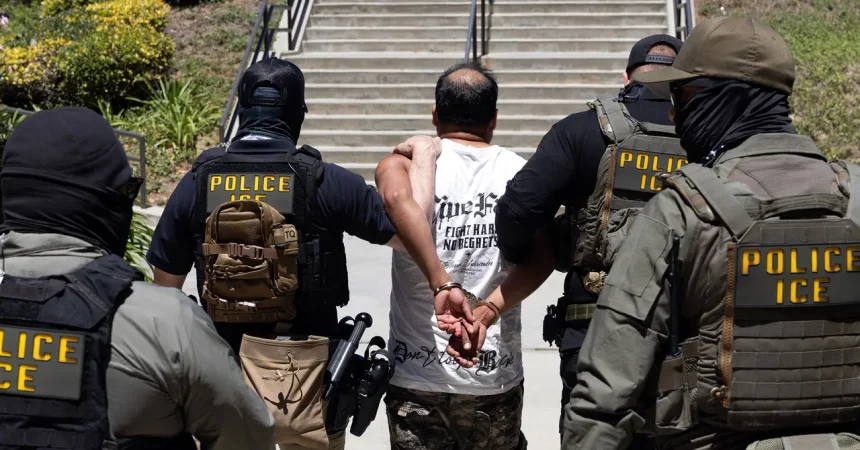
Imagine you are a caseworker at a nonprofit that helps immigrants navigate the civic landscape—maybe you help people apply for citizenship, register to vote, or simply understand their rights. One morning, you learn that the Department of Homeland Security has been quietly collecting information about organizations like yours, looking for any hint that they might be helping noncitizens register to vote. Then you hear that Immigration and Customs Enforcement is building a system to track people it believes have voted illegally, using a commercial data tool backed by Palantir, the same kind of software used to target deportation suspects. It feels like a scene from a surveillance thriller, but according to documents obtained through a Freedom of Information Act request and published this week by the legal advocacy group Democracy Forward, this is not fiction. As the Trump administration has carried out a relentless effort to undermine confidence in this year’s midterm elections, DHS appears to have explored using a Palantir-supported tool to identify and track people suspected of illegal voting—a move that blurs the line between election integrity and immigration enforcement.
The documents shine a harsh light on how deeply ICE has become embedded in federal voter fraud investigations. DHS officials have investigated more than 150 nonprofit groups in search of evidence that they are helping noncitizens register to vote. Meanwhile, Homeland Security Investigations—one of ICE’s two major components—is spearheading the charge, and its internal Innovation Lab, known as iLab, is developing new tools for agents in the field. One of the most striking revelations is that HSI wants to feed voter registration data into a system called ELITE, which stands for Enhanced Leads Identification & Targeting for Enforcement. This is not a hypothetical plan buried in a memo; it is happening in real time, with agents coordinating across units and sharing updates with the White House. The language in the emails is telling. An HSI worker in the Countering Transnational Organized Crime unit wrote in May about iLab’s processing of voter rolls and U.S. Citizenship and Immigration Services data, noting that criminal histories were “currently excluded” but that efforts were underway to address that gap. The ultimate goal, the email said, was to ingest processed voter roll data into ELITE to enhance “lead management, analytical review, and investigative tracking.” In other words, the machinery built to find and deport undocumented immigrants is being adapted to find and prosecute voters.
ELITE itself is a powerful tool, first reported by 404 Media, that gives ICE agents the ability to create maps of potential deportation targets, pull up files on each person, and see a “confidence score” for their current address. It is the kind of predictive, data-driven enforcement system that civil liberties advocates have long warned about—one that can assemble a picture of a person’s life from fragments of public records, immigration files, and other data sources, then decide whether to investigate them. The idea of adding voter roll data to this mix is deeply concerning, because it means that merely being registered to vote could flag someone for immigration enforcement, regardless of whether they are actually eligible. Palantir, the data analytics company that supports ELITE, told WIRED that “voter roll data has never been integrated into ELITE.” But the internal documents suggest that the integration is at least being considered, and that some states’ data had already been “enriched” by the iLab and was “pending Palantir entry into ELITE” as of early July. A July 7 email with an attachment named “Fraud WAR”—a weekly activity report—listed Connecticut, Georgia, Kentucky, Missouri, Michigan, and New Mexico as states whose data had been processed and were waiting to be loaded into the system.
To understand why this matters, you need to step back and look at the broader context. The Trump administration has repeatedly claimed, without evidence, that widespread voter fraud is happening, particularly in immigrant communities. This narrative has been used to justify everything from harsh rhetoric to restrictive voting laws, and now it is being operationalized inside DHS. The agency is not just talking about election integrity; it is building infrastructure to investigate suspected illegal voters, and ICE is at the center of that effort. The choice of ICE is significant. ICE is the agency responsible for immigration enforcement, not election administration. Its agents have broad powers to detain and deport people, and its data systems are designed to identify and track noncitizens. When you combine ICE’s enforcement machinery with voter registration data, you create a powerful tool for intimidation. Even if the system never results in a single prosecution, the mere possibility that immigration agents might show up at your door because your name appears on a voter roll could chill eligible voters—especially naturalized citizens, dual nationals, and people in mixed-status families—from participating in elections. This is the human reality behind the redacted emails and technical jargon: ordinary people may be afraid to exercise their constitutional right to vote, because they fear the government is watching them.
The documents also raise serious questions about the accuracy and fairness of such a system. Voter rolls are notoriously imperfect; they contain outdated addresses, duplicate names, and other errors. If ELITE assigns a “confidence score” to a person’s address based on voter data, a minor mistake could send agents to the wrong home, targeting a lawful permanent resident or even a U.S. citizen. Noncitizen voting is already illegal and extremely rare, but building a system to catch it risks sweeping up countless people who have done nothing wrong. The email from the HSI worker acknowledges that criminal histories were initially excluded, which suggests the agency is still deciding what data to include. But the fact that it is working to add criminal histories to a voter fraud tool suggests a broader ambition: to create a complete profile of every person who appears on voter rolls, whether they are suspected of a crime or not. This is reminiscent of the “chilling effect” that civil rights groups have warned about for years—when the government uses surveillance to police political participation, it undermines the very idea of democratic consent. Fordham Law School professor Chinmayi Sharma, who has tracked ELITE closely, told WIRED that ICE seems to want to build “a system that is going to get good at determining how to find people to investigate and potentially bring action against.” That may sound like a straightforward law enforcement goal, but in the context of elections, it becomes something more dangerous.
What makes this revelation particularly troubling is the lack of transparency and oversight. The emails were obtained only after a legal fight under the Freedom of Information Act, and much of the actual substance is hidden behind redactions. We don’t know exactly which nonprofits were investigated, what criteria were used to flag potential illegal voters, or whether any U.S. citizens have already been caught up in these data dragnets. A DHS official in the July email chain said that someone from the agency would send the update to the White House, indicating that this is not a rogue operation but a coordinated policy effort. The fact that the White House is being briefed on voter fraud investigations driven by ICE suggests that the administration sees these tools as part of its political strategy, not just an administrative function. It is one thing to run a law enforcement operation in response to credible evidence; it is another to build a predictive system that targets entire communities based on their demographics or immigration status. The people most likely to be affected are immigrants, people of color, and low-income voters—groups that have historically faced barriers to voting and are already suspicious of government overreach. By arming ICE with voter data, the administration risks creating a two-tiered system of justice: one for elites and another for the vulnerable.
In the end, the story is not just about a software tool or an email chain. It is about the fundamental character of our democracy. Elections are supposed to be the moment when the people decide who holds power, not the moment when the state decides who gets to participate. The whispers of voter fraud have been used for years to justify restrictions on voting, but the idea of using immigration enforcement to police the ballot box takes that movement to a new and dangerous level. It says to every naturalized citizen, every immigrant family, every person who doesn’t look or sound like the majority: “We don’t trust you. We are watching you. And if you step out of line, we will find you.” That message is incompatible with the promise of equal citizenship. The documents released by Democracy Forward are a warning, but they are also an invitation. They invite us to demand answers, to hold our leaders accountable, and to defend the right to vote from those who would use surveillance to undermine it. We need more than denials from Palantir and vague statements about voter confidence. We need congressional oversight, independent audits, and a guarantee that voter rolls remain in the hands of election officials—not ICE agents. Otherwise, the machinery created to protect our democracy may end up destroying it, one “confidence score” at a time.