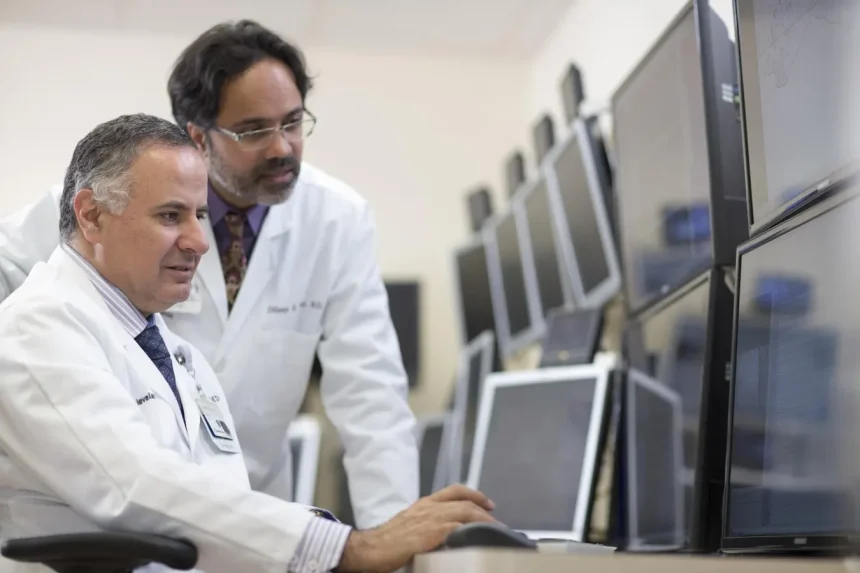
Imagine being a hospital technician faced with a wall of screens showing the brainwaves of dozens of patients, each one a tangle of squiggly lines that have to be watched for subtle signs of trouble. Reading a single day of EEG data can take a trained specialist two hours. Now imagine an AI that could watch all of those signals at once, alerting doctors the moment something goes wrong—like a heart monitor that beeps when a pulse flatlines, but for the brain. That’s the promise of a project between the Cleveland Clinic and a New York startup called Piramidal. They’ve built an AI model trained on EEG data, the electrical activity picked up by electrodes on the scalp, to detect seizures and other abnormalities in real time. The hospital system and the startup have been working together for more than a year, and after a successful pilot study, Piramidal has submitted the model to the FDA for clearance. In that pilot, the AI correctly spotted nine out of ten seizures and kept false positives below 10 percent. Dr. Imad Najm, director of the Cleveland Clinic Epilepsy Center, is cautious but hopeful. “Our goal is to develop a technology that helps us as clinicians improve outcomes in patients,” he says. “Our challenge is to make sure that when we talk about AI in healthcare, that it is trusted.” The human side of this is immense: patients in intensive care, families waiting for answers, overworked staff. The hope is that AI doesn’t replace the experts, but gives them more time to focus on the people who need them most.
For now, the AI’s first job is to help hospitals keep pace with a surge in demand for continuous EEG monitoring. The Cleveland Clinic currently monitors between 70 and 120 patients across its 20 hospitals in Ohio and Florida, and technicians are expected to pore over every bit of the data. The new AI system, built by Piramidal founder Dimitris Fotis Sakellariou, a computational neuroscientist who went through Y Combinator and raised $6 million in seed funding, is designed to flag abnormal brain activity instantly, even sending alerts to a neurologist’s phone. Sakellariou describes it as a safety net for the brain. “The AI can monitor hundreds or even thousands of patients in real time,” he says. The Cleveland Clinic plans to open a centralized hub for large-scale EEG monitoring at its new Neurological Institute in early 2027. After that, the bigger goal comes into view: applying the AI to epilepsy treatment. The clinic runs one of the largest epilepsy programs in the world, and doctors there don’t just need to know that a seizure is happening—they need to know where in the brain it starts, because that determines whether a patient can be treated with medication, surgery, or implants. To teach the AI that spatial and diagnostic skill, the clinic is building a library of annotated videos of epilepsy patients, including roughly 6,000 people who have had surgery for the disorder there. Najm hopes to test the epilepsy-specific model in late 2027. “This would be transformational in the field of epilepsy surgery and treatment in general,” he says. Behind those words are real people: a child whose seizures resist drugs, an adult weighing brain surgery, a family desperate for a plan. If AI can help point to the exact origin of a seizure, it could change the path from years of trial-and-error to a faster, more precise treatment.
Fidji Simo’s career seemed to peak in May 2025, when she started a dream job as the second-in-command at OpenAI, working with Sam Altman. Externally, she was helping lead some of the most powerful AI applications in the world. But privately, she was fighting her body. Simo has postural orthostatic tachycardia syndrome, or POTS, a chronic and often misunderstood condition. Simply sitting up or standing can make her heart race and her blood pressure drop so dramatically that she faints. The pace at OpenAI made things worse. “Unfortunately, it’s very, very hard for me to stand without passing out. I can’t sit or stand so long—more than five or ten minutes, I pass out, which is very inconvenient to say the least,” she says. By July, she stepped down from OpenAI, though she remains an adviser. Rather than retreating, she turned her frustration into a new mission. Simo had already, in March 2025, quietly launched a startup called ChronicleBio with Rohit Gupta, a biobank expert who had worked at Stanford and UCSF, and Rishi Reddy, a managing partner at Tarsadia Investments. Gupta is CEO; Reddy is executive chairman; Simo is cofounder. Their focus is a cluster of chronic immune-related conditions that affect perhaps 250 million people worldwide: POTS, long COVID, and myalgic encephalomyelitis/chronic fatigue syndrome (ME/CFS). For decades, people with these illnesses have been dismissed, struggled to get proper care, and been told there’s nothing objectively wrong. The founders believe the real problem is that the names themselves are too broad and vague—they’re labels stuck on a tangle of symptoms, not coherent diseases. To sort them out, ChronicleBio is collecting blood from patients and analyzing it at a scale few have attempted.
ChronicleBio has gathered nearly 200 terabytes of data from more than 1,000 patients, with around 9,800 tubes of blood converted into 40,000 vials stored in its biobank. From each sample, the company measures more than a billion data points, including 2,000 metabolites and 1,000 proteins. That’s a mountain of biology, and the company is trying to find patterns that current medical tests miss. Enrollment has been happening in Utah, Arizona, Texas, and India, and the team has started using mobile phlebotomy units to reach homebound patients who cannot travel to a clinic—a detail that shows how deeply chronic illness can remove people from normal life. So far, the analysis has identified five distinct subtypes of ME/CFS, and, after looking at adjacent conditions, 13 subtypes across the broader chronic illness landscape. If the patterns hold, the implications are enormous. “We think these conditions are names that doctors have put on symptoms, and we think there is a lot of heterogeneity,” Simo says. “If a condition is really 10 conditions, it’s much harder to develop a drug.” In other words, a clinical trial that mixes all those subtypes together may fail because the drug works for one subtype but not others, or because side effects in one group hide benefits in another. Better classification could mean faster, more targeted trials and, eventually, treatments tailored to the actual biology a person has, not a catch-all diagnosis. The company has raised $20 million from investors like Breyer Capital, Wisdom Ventures, Proximal Ventures, and Stripe cofounder Patrick Collison. It’s early days, and the science is difficult, but the mission is personal for Simo. She’s not just building a company to make money; she’s trying to find a way out of the maze that has trapped her—and millions of others—in a medically vague no-man’s-land.
Not all the news in the newsletter is about treating disease. Some is about the financial decisions of people who claim they want to build a better state. Vivek Ramaswamy, the biotech billionaire running for governor of Ohio, has a plan: eliminate Ohio’s tax on capital gains starting next year, and eventually phase out the state income tax entirely. He argues that such a move would bring “founders… in droves.” But Forbes estimated that Ramaswamy saved about $12.3 million in state and local taxes by moving from New York to Ohio in late 2019, just before a huge windfall from his company Roivant Sciences. That’s not illegal, and tax lawyers are quick to point out that the wealthy routinely minimize their tax burdens by timing relocations. “People are always doing things like this. It’s completely allowed,” says Timothy Fogarty, a tax professor at Case Western Reserve University. Still, the optics are complicated: a politician who wants to slash taxes for investors has personally used the very system he wants to change, in a move that looks less like a lifestyle choice and more like a financial one. The story is a reminder that “the rich are different” has never been more true. The tax code is riddled with provisions that reward people who can structure their lives around wealth—changing a home, changing a state, timing an exit. A regular Ohioan who works a job and pays income tax doesn’t have that kind of flexibility. Ramaswamy, who is 41 and worth an estimated $2.3 billion, has made tax policy a centerpiece of his campaign, presenting it as a way to attract innovators and grow the economy. But his own relocation shows, in the most concrete terms, how state borders can become a tax planning tool for the wealthy.
The InnovationRx newsletter also rounds up a broader set of health and science headlines. One of the most heartening pieces of news: three neuroscience researchers won the Nobel Prize in Physiology or Medicine for their breakthroughs in optogenetics—a technique that uses pulses of light to turn specific groups of neurons on or off, essentially giving scientists a remote control for the brain. It’s a beautiful idea, and it’s already helped uncover how circuits produce behaviors. A more discouraging headline involved Oura, the maker of popular smart rings, whose stalled IPO offers a cautionary tale about consumer companies that dress up health devices as tech platforms, with thin margins and uncertain growth. Then there was a tragedy that underscores the human cost of insurance bureaucracy: a patient died by suicide after a delay in getting approval for medication for his lung disease. In Utah, a startup called Nolla Health got permission to use its AI to prescribe common acne medications with limited doctor oversight—a small experiment in letting machines take on more clinical responsibility. Another strange story: an international health agency partnered with candy giant Ferrero to help fund vaccinations in Ecuador, then quietly terminated the deal, raising questions about why it ended. Harvard biologist David Sinclair’s lab reported discovering small molecules that can reprogram cells to a younger state, which sounds like science fiction until you remember that aging research is moving faster than ever. Finally, there’s the political reality: Republicans attempted to postpone health care cuts until after the midterm elections, but voters are already feeling the squeeze. The newsletter, in other words, captures the full spectrum of medicine and innovation—from technical triumphs to maddening setbacks, from well-funded billionaires to patients left waiting for answers. If the thread connecting them can be summarized, it’s this: health care is increasingly being torn between artificial intelligence, financial incentives, and human frailty. The stories are a reminder that behind every algorithm, tax break, and blood sample, there’s a person trying to live a little longer, a little healthier, a little more comfortably.