Imagine looking up at the night sky hundreds of years ago and seeing a bright new star where none had been before—a “guest star” that appeared without warning, lingered for a while, and then faded from view. That is exactly what medieval skywatchers are believed to have witnessed during the Middle Ages: a supernova, a dying star’s final, spectacular explosion. Now, astronomers have taken a remarkable step closer to understanding that ancient event. They have obtained the most detailed image ever made of Pa 30, the glowing cloud of debris left behind by that long-ago explosion. The new portrait of this supernova remnant is not just a beautiful image; it is a scientific revelation. It reveals structures that had gone completely unnoticed in earlier observations, and those structures are challenging what astronomers thought they knew about the chaotic aftermath of stellar death. With every sharper look at Pa 30, the story becomes richer and stranger, pulling together threads from medieval history and cutting-edge astrophysics, and reminding us that the universe’s most violent moments can leave behind remarkably delicate and ordered patterns.
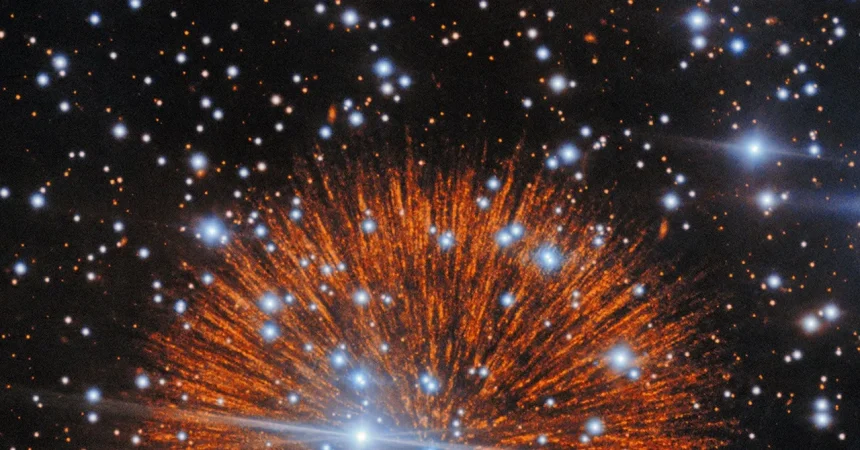
Earlier images of Pa 30 had already captured something striking. The remnant appeared as a sphere of long, thin, filament-like strands of glowing matter, spreading outward from the site of the explosion. To many eyes, those strands looked like a magnificent cosmic firework, frozen at the instant of its burst; to others, they resembled a dandelion in full seed, with delicate lines radiating in every direction. That shape alone made Pa 30 a favorite subject for astronomers and a compelling image for the public. But the new observations, made with the Gemini North telescope in Hawaii, have transformed that picture entirely. By using the telescope’s powerful imaging equipment, researchers were able to see far more detail than ever before—roughly ten times more structural detail than any previous image of the remnant had revealed. This extraordinary resolution did not simply make the same old filaments look sharper. Instead, it changed how the filaments themselves appear. What had once seemed like smooth, continuous strands of gas turned out to be something very different. The filaments are not unbroken lines at all. They are more like beads on a string, composed of individual knots of gas that exist in a neat sequence along each strand. The discovery of this beaded structure opens a whole new set of questions about how supernova debris is organized in the centuries and millennia after an explosion.
These “cosmic pearls” are, by human standards, unimaginably vast. According to the study published in The Astrophysical Journal, each knot measures about four light-days in diameter. A light-day is the distance that light travels in a single day—roughly 16 billion miles—so four light-days is an almost incomprehensible distance. Yet the image shows these enormous beads arranged with surprising regularity. Ilaria Caiazzo, a coauthor of the study, highlighted just how big they are by asking us to compare them with our own neighborhood. “The planetary region of our solar system could fit in each knot about 10 times with room to spare,” she said in a press release. In other words, were you to take the entire region containing the Sun, the planets, and their orbits, you could place it inside one of these knots ten times over and still have space left. What makes this even more curious is how uniform the knots are. They do not vary wildly in size or shape. They are relatively consistent, lined up like pearls on a necklace. Caiazzo and her colleagues are clearly excited by this unexpected order. “The knots are quite strikingly uniform,” she said. “We are excited to try to model them.” That combination of enormous scale and strange regularity is exactly the kind of detail that can help scientists refine their understanding of how supernovae create and shape the material that eventually spreads through space.
How exactly these pearls formed remains something of a mystery, but the basic idea is clear enough: they are concentrations of material that were thrown outward during the explosion. When a massive star reaches the end of its life, it can collapse and then rebound in a tremendous blast, scattering its outer layers into space at extraordinary speeds. That ejected material goes on to interact with itself, with surrounding gas, and with radiation, creating shock waves, turbulence, and all sorts of complex structures. In the aftermath of such a violent event, astronomers might naturally expect to find chaotic, clumpy, irregular accumulations of gas and dust. Instead, the knots in Pa 30 are relatively even in size and appear aligned along the filaments, as if some hidden force had organized them. This peculiar order is a new feature of the remnant, and it is precisely the kind of detail that could help researchers gain a deeper understanding of stellar death. The strange uniformity may point to particular physical processes at work in the expanding debris, perhaps related to the way the explosion’s shock wave interacts with the material around it, or to the way magnetic fields influence the movement of charged gas. By studying these structures, astronomers can test their models of supernovae and learn why some explosions leave behind such tidy patterns while others leave only chaos.
The importance of this discovery goes beyond one beautiful image of one glowing nebula. Supernovae are among the most important events in the universe. They forge and scatter the heavy elements that make up planets, and indeed the very atoms in our bodies. Understanding how supernova remnants evolve is therefore part of a much larger story—a story about the life cycle of matter, the enrichment of galaxies, and the conditions that eventually allow worlds like Earth to exist. Pa 30 offers a rare chance to study a supernova remnant with a known historical date. Because medieval observers recorded seeing the explosion, astronomers know exactly how long the debris has been expanding. That timeline makes it possible to connect the structures observed today with the physical circumstances of the original event. The new discovery of the beaded, pearl-like knots adds a fresh layer to that investigation. It suggests that even in the midst of a titanic explosion, surprisingly organized structures can emerge, and that the cosmos is capable of a kind of order that our theories do not yet fully predict. The findings may also have practical implications for other remnants, giving astronomers a new pattern to look for when they examine the aftermath of other stellar explosions.
This image, obtained with the Gemini Multi-Object Spectrograph, shows that the ejecta from the remnant—with its unmistakable fireworks-like shape—form a cascading structure resembling a knot. The visual effect is stunning, but the science is even more so. Every new observation of Pa 30 peels back another layer of mystery around an event that human beings witnessed centuries ago. Those medieval observers could never have known that their brief sighting of a new star would one day be studied with giant telescopes in Hawaii, revealing cosmic pearls thousands of times larger than our entire solar system. They saw a point of light; we see a complex, evolving structure made of matter that was once inside a dying star. The new image is more than a technical achievement. It is a bridge across time, linking the curiosity of ancient skywatchers to the tools of modern astronomy. And it reminds us that the universe is still full of surprises. The knots in Pa 30 are measured, cataloged, and beautifully resolved, but they still hold their secrets. How did they form? Why are they so uniform? What can they teach us about the last moments of a star’s life? Those questions now belong to astronomers and modelers, who will try to recreate the conditions that produced these strange and lovely pearls. For the rest of us, the image is a humbling reminder that even in destruction, the universe can create patterns of staggering beauty—and that the story of a star’s death is never truly finished.