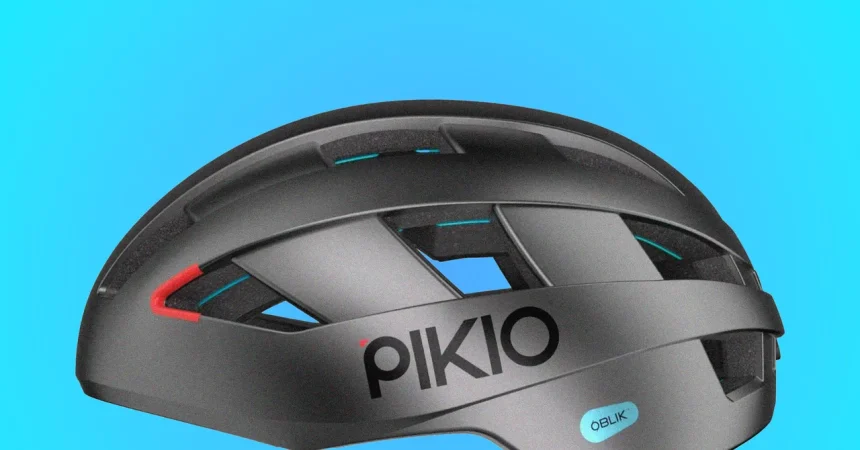
Helmet safety used to be a simple equation: foam absorbs the blow, straps keep the helmet in place, and your skull walks away. But the more we understand about what happens to the brain inside the skull during a crash, the more we realize that straightforward impact is only part of the danger. Rotational forces, the twisting and shearing movements that occur when your head glances off the road, are now understood to be especially harmful. They are associated with concussions and more serious brain injuries because they can stretch and tear neural tissue in ways that a straight impact alone might not. That understanding has driven a quiet revolution in helmet engineering. The new battleground is not just how much energy a helmet can absorb, but how it redirects rotational energy before it reaches the head. It is here that the Pikio has pushed to the top of independent STAR testing, beating its closest rivals in a way that deserves attention. The Canyon Deflectr RLS, the second-best STAR-tested helmet, and the 3D-printed Hexr Miden RLS, which came third, both use an external Release Layer System. Their outer shell panels float on tiny polycarbonate ball bearings. In a crash, those panels can roll and detach, sending rotational energy skidding sideways rather than transmitting it into the brain. Pikio’s approach is different. Instead of letting the outside of the helmet do the sliding, Pikio tackles that same problem from within, using separate foam sections, intricately engineered flexible connection points, and dual-density construction. It is a more architectural solution. The helmet looks almost ordinary from the outside, but inside, it is closer to a controlled mechanism than a piece of molded foam. And in a lab that measures not just linear force but rotational acceleration, that mechanism appears to be working.
Lab testing can tell you a great deal, but it cannot tell you how a helmet behaves when it hits the ground at an awkward angle, with the full weight of a rider behind it, in the chaos of a real crash. Real-world data is precious blended with grim. It is also difficult to collect, because every piece of data begins with someone having had a very bad day. Pikio seems to understand that. If a Pikio helmet is ever called into serious action, if it is truly put to the test and damaged, then the rider will need to replace it, as with most EPS foam designs. But Pikio wants that damaged helmet back. The company offers a 30 percent discount on a replacement, and asks riders to send in the evidence of what happened. Abram, the person behind the company, says that so far, four helmets have been returned and replaced. For a new brand, four is a tiny number. But each one of those helmets represents a story that could have ended very differently. “Each has proven invaluable,” Abram says. “Not least because they’ve done their job and kept riders safe.” There is something deeply human about this. A helmet in a laboratory is a dummy head, a falling weight, a graph. A helmet that comes back from a real crash is dented, scuffed, and perhaps carrying traces of gravel and sweat. It takes trust for a rider to hand that helmet over to the maker. It takes even more trust to buy another one afterward. But Pikio understands that the most honest marketing is not a sponsored athlete or a wild claim. It is the quiet evidence of a cracked shell from a rider who got back up, called someone they loved, and lived long enough to be mildly annoyed about having to buy a new helmet.
At $379, the Pikio is unashamedly premium. That is a cool $219 more expensive than the second-best STAR-tested helmet, the Canyon Deflectr RLS. You can buy a very decent everyday bicycle for half that amount, and you can buy a very good helmet for a fifth of it. The price is a lot to swallow. The reason, as with most expensive things, is that no shortcut has been left untaken. Abram says that a standard cycling helmet contains around eight to ten parts. The Pikio Si, by contrast, uses around 80 individual components. That number alone hints at how different this helmet is inside. The separate foam sections, the intricately engineered flexible connection points, and the dual-density construction all add to the cost. It is not just that there are more pieces; those pieces need to be precise, and they need to fit together in ways that will move exactly as intended under the awful complexity of a crash. Each connector, each layer, each carefully shaped piece of foam has to work with the others. The manufacturing process is vastly more complicated than simply pulling a plastic shell over an EPS liner. The time, the tooling, the testing, and the assembly all add up. It is a small price to pay if it saves your life, but that is easy to say from the safety of a chair. What matters is whether the helmet actually serves you on a normal Tuesday, whether it feels good, whether it invites you to ride, and whether you are willing to put it on every single time. A helmet that sits in a cupboard because it is too heavy or too hot protects no one. So the real question is: how does the Pikio feel not in a lab, but in the bike lane, on a climb, in the rain, and at the end of a long ride?
I have been riding with the Si Oblik for the past month, and I have been impressed by how few compromises there are in the pursuit of protection. At 279 grams in medium size, it is respectably light, though not class-leading. Some road helmets simply disappear from your awareness; the Pikio does not disappear entirelyring? Rather, it makes its presence known. It is a little bulky for a road lid, a little rounder and more upright than the sleek aerodynamic race helmets that crowd the market today. But after a few minutes, you stop thinking about its shape. The dial-to-fit cradle hugs my head neatly without pinch points. It does not press on my temples, slide around, or need constant adjustment. The 17 air vents keep my head refreshingly cool, even when the heat and the gradient are both rising. Nobody has laughed at me for wearing it, at least not yet. Maybe they are being polite, or maybe they have better things to do than judge another cyclist’s headwear. Either way, the Pikio is a comfortable place to live. That is important, because a helmet can be the most protective object ever made and still be useless if it is so unpleasant that riders leave it behind. For me, the Pikio has not been a punishment. It has simply been a part of my kit. I have spent entire rides with my mind on the road, not on my helmet, and that is the highest compliment I can give. It is a little bulky, but the bulk is not by accident. It is the visible architecture of a helmet that has chosen internal rotation management over a slim silhouette.
My only real complaint during the month was the buckle under the chin. I have grown fond of magnetic Fidlock fasteners. They snap together with a satisfying click, can be operated with one hand, and make getting out of a helmet almost too easy. It feels like a premium touch, the kind of small luxury that turns a piece of safety equipment into something you actually enjoy wearing. So why did Pikio not use one? Abram’s answer was swift and technical. “Fidlock weighs around 13 grams; a buckle is just four grams.” That difference of nine grams may not sound like much, but in a helmet designed to manage rotational accelerations, mass matters. Nine grams sitting under the chin is not simply dead weight. It contributes to the same rotational inertia that the helmet is working to control. A magnetic fastener is a nice modern convenience, but the traditional four-gram buckle is lighter, simpler, and has fewer moving parts to fail at exactly the moment you need something to hold. It is a small but telling example of Pikio’s design philosophy. Every gram is interrogated. Every component has to justify its existence. The company is not chasing comfort features for their own sake; it is chasing survival. That is both admirable and slightly extreme. Some of the nice-to-haves we have come to expect from premium helmets are absent. There is no magnetic closure, no especially plush liner, no aero-tail flourish. Instead, there is a dense, purposeful web of foam and connectors, designed less to make you feel special than to keep your brain exactly where it should be. And ultimately, that is the trade-off. A helmet that is comfortable enough to forget, and engineered enough to be remembered only when it fails.
So where does that leave the Pikio? It is not the helmet for someone who buys on price alone. At $379, it is a luxury item, and no amount of engineering can change the fact that it is a significant purchase. But if you are the kind of rider who imagines the impact, perhaps because you have been hurt before, or because you know someone who has, then the Pikio offers something that the spec sheet cannot fully capture: a sense that you have done everything possible. The STAR test is one thing; the four returned helmets are four small, powerful data points. Abram says that each returned helmet proved invaluable because it did its job. That phrase deserves attention. A helmet that has done its job is not a helmet that looks good in a display case. It is a helmet that has absorbed the crash so that the head did not have to. It has sacrificed itself, and the rider has walked away. If that is not worth paying a little extra for, I do not know what is. The Pikio is not perfect. It is a bit bulky. The buckle is old-school. The price stings. But after a month of riding, I have no desire to take it off and no hesitation about putting it on. The highest praise a safety product can earn is trust. The Pikio has earned mine. I hope I never need to send mine back through the replacement program, but I am oddly comforted to know that the option exists. In a world full of marketing claims, Pikio seems to be doing something real. That is rare. And that is worth protecting.