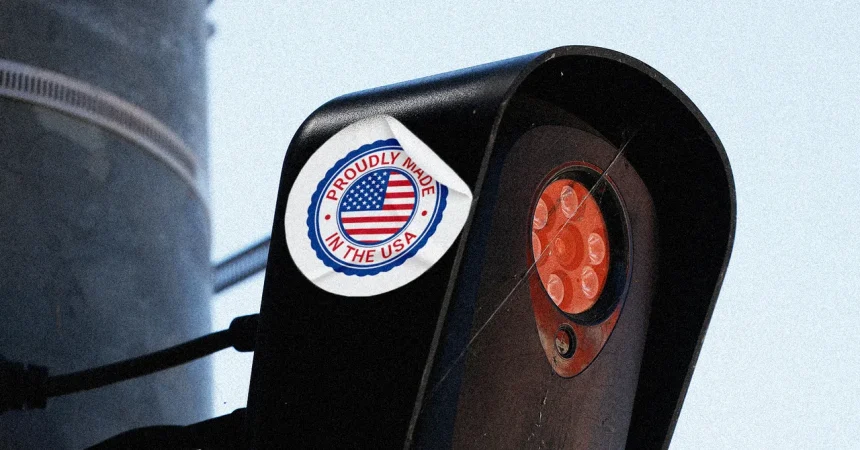
It began with drill marks. Garrett Langley, Flock Safety’s CEO, has often told the story of how the first license-plate cameras built under the Flock name came together on his dining table in Atlanta, leaving a permanent constellation of screw holes scratched into the wood. It is the kind of origin story that makes a young company feel scrappy and disarming: a founder hunched over a homemade gadget, a soldering iron, a good idea about using cameras to fight crime. But a decade after those first crude prototypes, the path from that dining table to tens of thousands of streetlight-mounted devices across the country has become far harder to trace. For years, Flock was happy to tell the world that its cameras were made in the United States. According to WIRED’s review of the company’s recent marketing materials, that clear claim has quietly disappeared from its public communications. The company no longer specifies where its cameras are manufactured, and when reporters started digging, the silence became more telling. One American manufacturer that had previously identified Flock as a customer removed that reference from its own website earlier this year, just as the backlash against Flock’s surveillance technology was intensifying. That kind of quiet deletion suggests a company becoming increasingly wary of being associated with a product so fiercely debated. But for all the controversy surrounding Flock’s cameras—the protests, the canceled police contracts, the proposed congressional action—almost no one has stopped to ask a basic question: Who actually makes these things, and why has the answer suddenly become so hard to find? The supply chain behind a license-plate reader is more than a logistical detail. It is a national security issue, a transparency issue, and a question about who really controls the hardware that is becoming a permanent fixture of American policing.
Flock has become a national flashpoint in the fight over surveillance, and the debate around it has mostly been about what the cameras do with the images they capture. There is no shortage of reasons to worry. A nationwide protest movement has pushed dozens of local governments to abruptly end their contracts with the company. Congress is considering legislation that would strip federal funding from states that fail to impose limits on Flock and other license-plate readers. Police departments insist the cameras are invaluable tools for deterring crime and solving cases, pointing to stolen cars found and suspects arrested because a camera saw a plate at the right moment. Activists tell a different story. They describe officers using the network to track the cars of people they know personally, footage being shared with immigration authorities, and a quiet expansion of monitoring that follows not just vehicles but pedestrians as well. These are serious and urgent concerns, and yet the physical object at the center of all this has received surprisingly little scrutiny. Where is the camera made? Who supplies its chips and sensors? Could the components be compromised? Those questions matter more than ever, because Flock’s cameras are not just gadgets sold to a few curious police departments. They have become a kind of infrastructure, mounted on public poles, watching roads in cities and suburbs across the country. If these devices are the eyes of American policing, then their inner workings and their origins should not be treated as a trade secret. The debate over what they do has been loud and visible, but the debate over how they are built has taken place in near darkness.
To reconstruct how Flock’s hardware pipeline has evolved, WIRED spoke with current and former Flock employees, consulted supply chain analysts, reviewed years of US import records, and watched old marketing videos in which Langley happily talked about the company’s early design philosophy. What emerged is a picture less of a single factory stamping out Flock cameras in the United States than of a global web of suppliers providing mostly generic parts that could power any number of consumer electronics. Langley himself said as much in a 2021 marketing video. “Our value is in the aggregation and the packaging of all of these things,” he said, describing how the company took a pile of components and wrapped them into “a nice waterproof, consumer-friendly device.” That phrase is revealing: the magic of Flock, according to its own founder, is not in building the cameras from scratch but in combining commercially available elements into a product designed for police work. Import data collected by ImportGenius appears to support that picture. The records show Flock increasingly importing “commodity” cameras, radar systems, and other components from Primax Electronics in Thailand. Primax is a Taiwan-based company with manufacturing facilities in China, Thailand, and elsewhere. Whether Primax is shipping individual parts or fully assembled camera units is not completely clear, but the data suggests a much deeper relationship than a simple purchase order. ImportGenius analyst Lynn Hughes noted that many of the shipments included the word “radar” in the product description, which may relate to the radar sensing pods Flock attaches to its cameras. “My understanding is that these are components, but it looks like Primax manufactures whole security camera solutions,” Hughes said. In other words, the company that makes Flock’s system may not be an American manufacturer at all, but a global electronics giant known more for producing computer peripherals and other hardware than for building license-plate readers.
Flock itself has little to say on the subject. The company did not respond to most of WIRED’s detailed questions for this story, but it did offer a general statement through spokesperson Paris Lewbel. “All products that Flock builds are National Defense Authorization Act compliant,” she said, referring to a US law that effectively prevents government contractors from using components made by a handful of Chinese technology companies deemed to pose national security risks. That answer may calm some fears about state-sponsored backdoors or deliberately compromised chips, but it is not the same as openness. Being compliant with a federal law is a legal baseline, not a promise of transparency. The law bars certain Chinese-made parts from being used in government-contracted equipment, but it does not tell the public where Flock’s devices are assembled, who exactly is in the supply chain, or why the company has scrubbed its marketing materials of any mention of American manufacturing. Cris van Pelt, creator of the anti-Flock advocacy project Have I Been Flocked, argues that the origin of the cameras may be less important than the lack of accountability around them. “It all speaks to the fact that there is no real oversight, and that tens of thousands of literal and figurative black boxes are being installed on American roads,” van Pelt said. “If any part of the supply chain is compromised, we would never know. That’s a much bigger problem than where the final product is assembled.”
The company’s early days, in hindsight, make the current secrecy feel almost ironic. Langley once described how the first Flock prototypes were made from cameras ripped out of Android phones bought on Alibaba, then wired to batteries and soldered onto solar panels. The goal was simple: prove that a useful license-plate reader could be built from parts that together cost only $200 or $300. If you could do that, the logic went, then you could sell a surveillance tool that was cheaper, easier to install, and harder for the average department to ignore. That jury-rigged urgency carried over into Flock’s first real office, which also served as an assembly line. Langley was candid about how unpolished it was. Pallets of parts shipped in from China had to be dragged a quarter of a mile through the building, sometimes several times a week, just to keep up with demand. It was fun, he said, but also exhausting and messy, a far cry from the polished manufacturing operations people normally associate with high-tech hardware. Those early compromises may have left traces that last to this day. WIRED reported earlier this week that Flock’s cameras still rely on smartphone-style processors and leave significant portions of their data unencrypted. That combination of sophistication and improvisation is perhaps the clearest way to understand Flock’s hardware: a product that has become brilliantly useful for police, but which has never fully escaped the improvisational spirit of its creation. It was built fast, marketed faster, and only now is the public beginning to understand the contours of what was actually installed.
The journey from Langley’s scratched dining table to an international supply chain is not unusual for a successful American startup. Many consumer products begin as handmade prototypes and end up assembled in factories far from home. But Flock’s cameras are not ordinary consumer products. They are law enforcement tools mounted in public space, pointed at public roads, continuously recording the movement of ordinary people. Their provenance matters in a way that a phone’s provenance does not. When a police officer buys a laptop or a radio, the public generally knows who manufactured it and where it came from. With Flock, the details have become murky just as the company’s reach has expanded and just as public scrutiny has intensified. The combination invites suspicion. It suggests that the company understands how controversial its products have become, and that it is reluctant to offer any new information that might make the controversy harder to manage. In one sense, the question of whether a camera is assembled in Thailand or Taiwan or the United States is not the most important issue facing Flock. The more urgent questions are about oversight, data access, invasions of privacy, and the quiet expansion of a surveillance network that most Americans never voted for. But the two sets of concerns are connected. A device that is opaque in its construction is easier to trust blindly, and that should worry everyone. If a company cannot tell the public honestly where its hardware comes from and who has touched it along the way, then how much trust should those same communities place in the company’s promises about data security, privacy protections, and fair use? The drill marks on the dining table told a story of invention and hard work. The silence around the supply chain tells a different story, one about growth, secrecy, and the difficult distance between a founder’s good intentions and a product that now watches over millions of miles of American streets.