The 2026 Worldwide Developer Conference (WWDC) served as a landmark moment in Apple’s history, functioning as both a massive technological pivot and a poignant changing of the guard. For years, the tech industry has watched Apple cautiously navigate the artificial intelligence gold rush, often feeling as though the company was lagging behind competitors who launched aggressive chatbot suites. This year’s keynote was designed to silence those critics. By unveiling a deeply integrated vision for “Apple Intelligence,” the company signaled that it is no longer just chasing the trend; it is attempting to redefine how AI feels when it lives inside your phone, tablet, and laptop. It was a high-stakes presentation that aimed to prove that Apple’s methodical approach to software would ultimately result in a more cohesive and meaningful user experience than the rushed implementations seen elsewhere.
Central to this new strategy is a high-profile partnership with Google. The integration of Google’s Gemini model as the backbone for Apple Intelligence was the highlight of the event, finally clarifying how the two tech giants intend to work together. Software chief Craig Federighi emphasized that this isn’t just about adding a chatbot to the home screen; it is about embedding intelligence into the very fabric of the operating system. Whether you are drafting an email in Mail, searching for a specific memory in Photos, or trying to understand a complex webpage in Safari, these new tools are designed to anticipate your needs. By combining Apple’s signature design philosophy with the massive computational power of Gemini, the company hopes to move beyond simple voice commands to a level of contextual awareness that feels genuinely helpful rather than gimmicky.
The most visible change for the average user will be the evolution of Siri. For years, Apple’s virtual assistant has been a subject of frustration, often struggling with nuance or complex requests. This year, Siri was reimagined as a modern AI chatbot capable of fluid, sophisticated conversation. Beyond just setting timers or playing music, the new Siri can analyze what is currently happening on your screen, reference documents stored across your apps, and provide results that feel tailored to your personal context. By allowing the assistant to peer into your workflow to help draft texts or summarize long documents, Apple is positioning Siri as a true digital collaborator. It is a necessary shift, transforming a tool that was once limited by rigid command structures into one that understands the intent behind your words.
While the technical capabilities are impressive, Apple was equally focused on the ethical implications of this new era. The company has long staked its reputation on privacy, and moving into a cloud-based, AI-heavy future poses a significant challenge to that brand identity. During the keynote, leadership took great care to explain their two-pronged approach to safety: keeping as much data as possible on the device itself—which will likely restrict these high-end AI features to their most recent, powerful hardware—and ensuring that any cloud-based requests are processed through highly secure, encrypted channels. This “privacy-first” marketing is the cornerstone of their pitch to users who are increasingly wary of how their personal data is used to train large-scale models. Apple is betting that consumers will favor their ecosystem specifically because they trust the company to guard their digital footprint more effectively than their peers.
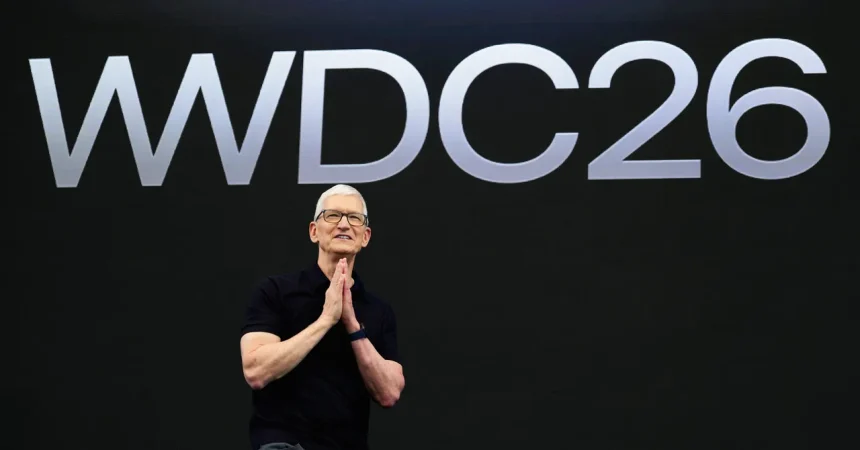
The event also marked a deeply emotional turning point for the company: it was the final WWDC for long-time CEO Tim Cook. After a decade of steady leadership that saw Apple’s market value skyrocket and its product ecosystem reach unprecedented heights, Cook’s closing remarks felt like a benediction. By signaling his transition to executive chairman this September and making way for John Ternus, the current head of hardware engineering, Apple is effectively closing the “Cook Era.” His final message—”I still believe the best is yet ahead”—was a nod to the shifting of the torch toward a new generation of leadership. Ternus will be stepping into one of the most demanding roles in corporate history, tasked with managing a company that is essentially reinventing its core interface at a time of massive professional and personal uncertainty.
Ultimately, WWDC 2026 was about more than just software updates; it was a blueprint for the next decade of life with our devices. By bridging the gap between Apple’s hardware-centric culture and the cloud-heavy future of AI, the company is attempting to keep its ecosystem relevant in a world where software is becoming increasingly automated. Whether these changes will fundamentally improve our daily lives or simply add another layer of complexity remains to be seen. However, by balancing the raw power of Google’s Gemini with the privacy-focused design that Apple’s users demand, the company has cleared the most significant hurdle in its recent history. As Tim Cook prepares to step aside, Apple has laid a foundation that looks designed to keep the company’s identity intact even as the nature of computing changes forever.