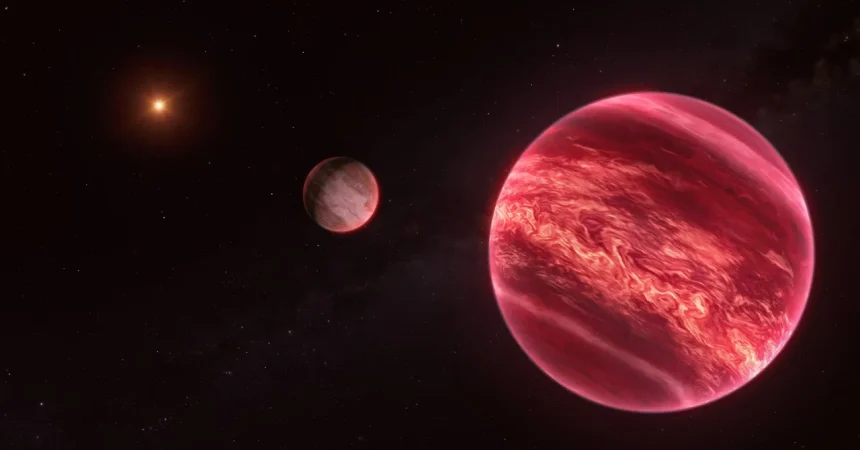
The discovery of a massive, moon-like object orbiting the brown dwarf CD-35 2722 B marks a fascinating new chapter in our exploration of the cosmos. To ensure this was a genuine find and not a mere glitch, the research team underwent a rigorous verification process. They meticulously ruled out external “noise,” such as errors stemming from Earth’s orbital motion, seasonal atmospheric shifts, or the intrinsic rotation of the brown dwarf itself. By successfully isolating the signal, the team confirmed they were looking at something truly significant: an “exosatellite” with a mass comparable to that of Jupiter, gracefully dancing around its parent body.
The scientific legitimacy of this object was further bolstered by an analysis of its orbital mechanics. By calculating the Roche limit—the point at which tidal forces would shatter a satellite—and the Hill radius—the boundary of the brown dwarf’s gravitational reach—the researchers confirmed that this satellite occupies a “Goldilocks” zone of stability. It is positioned perfectly where it can endure without being pulled apart or flung into deep space. This discovery stands as a historic milestone, representing the first clear evidence of a satellite orbiting a brown dwarf companion, edging out earlier, inconclusive glimpses caught by other teams using the VLT Interferometer.
However, labeling this object brings us to a philosophical crossroads in astronomy. In our own solar system, the definitions are tidy: planets orbit stars, and moons orbit planets. But in the strange, blurry world of brown dwarfs—which are essentially failed stars—the lines between categories begin to dissolve. As astrophysicist Alice Zurlo notes, the conventional framework we use to describe our own backyard simply doesn’t hold up here. Because we lack a formal, universal definition for what constitutes an “exomoon,” the team has opted for the more technical term “exosatellite,” acknowledging that our current language is struggling to catch up with the complexity of the universe.
The ambiguity surrounding the object’s classification does not diminish the excitement of the find; if anything, it highlights how much we have yet to learn. The research team remains humble, noting that while they haven’t settled the debate on whether this object should be formally dubbed a “moon,” the discovery itself acts as a crucial proof of concept. By successfully detecting it, they have cleared a path for future observations, turning a once-theoretical possibility into a concrete target for study. It is a necessary step forward in refining the tools and techniques that will eventually allow us to map the invisible architecture of distant systems.
Looking ahead, the implications of this discovery ripple through several fields of science, from celestial mechanics to the search for life. If large gas-giant satellites exist around brown dwarfs, it is entirely possible that smaller, rocky moons—more akin to the ones we recognize—are also present. These smaller bodies could potentially experience tidal heating, a process that might warm them enough to create habitable environments, even in the freezing darkness of deep space. This broadens the horizon for astrobiology, suggesting that life might find a foothold in places we previously dismissed as too hostile or distant to be relevant.
We are standing on the precipice of a new era of clarity. With the upcoming construction of the Extremely Large Telescope, featuring a massive 39-meter primary mirror, astronomers will soon possess the sensitivity required to see even smaller, more elusive exomoons. What began as a complex signal detection exercise has evolved into a gateway for future exploration. As we continue to challenge our traditional definitions of stars, planets, and moons, we move closer to understanding the true diversity of our universe—a vast, interconnected web where the unexpected is becoming the new standard for what we consider normal.