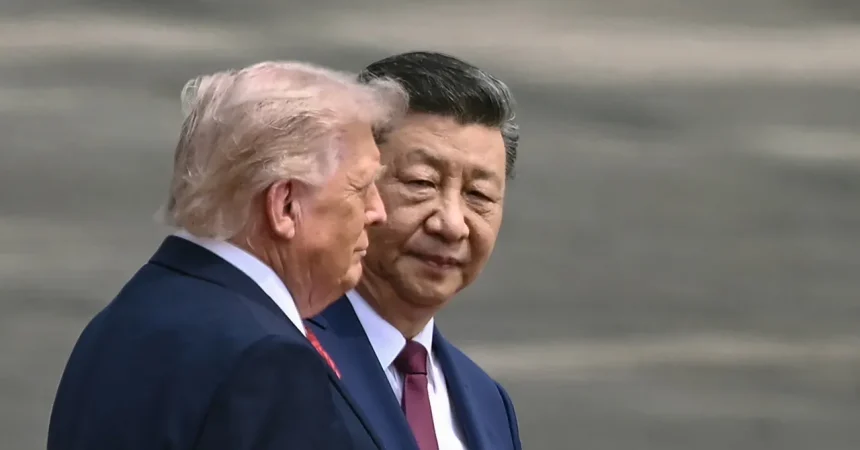
If there is one image that will define this week’s diplomatic calendar, it is the handshake between Donald Trump and Xi Jinping. The United Nations General Assembly has brought heads of state and foreign ministers to New York, but the meeting the world is actually watching won’t happen in the glass-and-marble corridors of the UN. Instead, the two leaders will come face-to-face at the White House, with a visit that has already broken protocol. On Wednesday, September 23, Trump is expected to personally welcome Xi at Joint Base Andrews, a gesture that American presidents rarely offer to visiting leaders. Usually, such honors are reserved for the closest allies, or for moments when a president wants to send a very particular signal. Here, the signal seems to be that this relationship matters more than any other, despite the long list of disputes and unresolved tensions hanging over it. Before the two men meet, however, the groundwork is being laid by a team of negotiators on both sides. A US delegation led by Treasury secretary Scott Bessent and trade representative Jamieson Greer is scheduled to sit down with China’s vice premier, He Lifeng, to shape the agenda and test the temperature. The World Economic Forum has already sketched out the main themes: trade conflict, supply chain vulnerabilities, technological rivalry, and the always explosive question of Taiwan. And all of this is taking place against a wider global backdrop that neither leader can fully control—including a war in the Middle East that continues to threaten wider escalation. In other words, this is not a simple bilateral meeting. It is a moment where economic strategy, military tension, domestic politics, and personal diplomacy all collide.
At the center of the conversation is a deadline. The trade truce that emerged from Trump and Xi’s meeting in Busan last year is set to expire on November 10, and both governments now have to decide whether to keep it alive. That agreement, fragile from the start, had pulled back some of the most aggressive tariff threats and paused certain port fees that had sent shivers through global shipping markets. Extending it is not just a technical decision; it is a political one, with each side trying to calculate how much they can extract from the other. The leaders may also set purchase targets for key trade items—agricultural products, energy, and Boeing aircraft have all been mentioned—as a way of proving that the relationship delivers real economic benefits. On top of that, there is a roughly $30 billion package of what officials call “non-sensitive” goods, spanning about ten categories, though no one seems to agree on exactly what counts as non-sensitive. That ambiguity leaves plenty of room for interpretation, and for negotiation. Perhaps the most delicate piece of the Busan puzzle involves rare earths and minerals. China had agreed to lift export limits on these critical materials, which are essential for everything from automobiles and defense systems to the advanced hardware that powers artificial intelligence. The United States, desperate for a more reliable supply, has found itself in the uncomfortable position of depending on the very competitor it is trying to contain. Beijing knows this. By keeping a firm grip on its dominant position in the global market, China has turned these minerals into leverage, a quiet but powerful tool in a trade war that has often been fought through public threats and rhetorical fireworks.
The conversation about trade naturally bleeds into a conversation about technology, and specifically about artificial intelligence. According to Scott Bessent, AI safety is expected to be a formal topic in the bilateral meeting, something that business leaders have been requesting for some time. But the business community is far from united on what the outcome should be. Beijing would like to see Washington relax some of its export restrictions on Chinese technology, arguing that these controls are unfair and disconnecting the global tech ecosystem. American companies, however, are caught between two anxieties. On one side, there is a growing movement, even within the tech industry, calling for a slowdown in AI development until safety mechanisms can catch up. On the other side, there is a deep fear that if the United States pauses its own progress, China will simply surge ahead and define the standards of the future. The result is a policy environment full of contradictions. President Trump has dismissed domestic calls for regulation, preferring to let American innovation run free, and yet the same administration is actively working to limit Chinese access to advanced chips and the machinery needed to make them. These issues are inseparable from trade, because export controls on semiconductors and related materials are themselves trade policies. The leaders cannot talk meaningfully about commerce without stepping into the realm of technology, and they cannot talk about technology without stepping into the realm of national security. That makes the AI discussion both urgent and awkward, a conversation where every phrase has to be chosen carefully.
Beneath the economic surface lie the geopolitical fault lines that could crack the entire meeting. Taiwan remains the most volatile subject. China has reportedly threatened to pull out of the summit altogether if the United States green-lights new arms sales to the island, which would be seen in Beijing as a direct challenge to its core interests. That threat alone frames the meeting as a high-stakes balancing act. The leaders are also expected to discuss China’s economic relationship with Iran, an area of deep concern for Washington, especially with the Middle East already in flames. And then there are the cases of detained foreign nationals, a recurring issue in US-China diplomacy that carries enormous emotional weight for the families involved. Neither side is expected to give much ground on any of these fronts. The tone will likely be cautious, careful, and deliberately ambiguous—each leader trying to avoid a public rupture while also refusing to cede influence. Taiwan, in particular, is a subject where even a misworded sentence can create a crisis, so both governments will likely keep their public statements vague and their private warnings firm. The broader truth is that fundamental shifts are unlikely. These are two powers with deeply different visions of the world, and no single meeting, no matter how historic, is going to resolve the contradictions between them. The hope, for now, is simply that the relationship can be stabilized enough to prevent a catastrophic breakdown, and that economic ties can survive the political storms that keep swirling around them.
If we step back and look at the whole picture, the positions are clear but not simple. Washington is pushing for greater access to Chinese markets and products, for reliable supplies of critical minerals, and for concrete commitments on security issues that matter to the United States. Beijing, for its part, wants relief from tariffs and restrictions, and a recognition that China’s technological development cannot be indefinitely blocked by American policy. Each side has leverage, and each side is playing on multiple boards. Africa, Latin America, the Middle East—these regions have become arenas where the US-China rivalry plays out in ways that are often invisible to the casual observer but deeply felt by the countries caught in between. At the same time, both governments are aware that they have a shared interest in preventing Taiwan and other geopolitical flashpoints from completely destroying the economic relationship. That relationship is too big, too integrated, too important to the global economy to simply throw away. The two leaders met in Beijing this past May, and that meeting was full of symbolic gestures—carefully choreographed moments designed to show goodwill and keep the dialogue alive. But when it came to the actual negotiating table, very few concessions were made. The question now is whether Washington will be different. Is there something about the setting, the timing, or the pressure of the moment that will push these two men toward real decisions? Or will they once again settle for a show of unity without substance?
The most realistic answer, according to those who study the relationship closely, is that the meeting will produce enough to look like progress, but not enough to change the fundamental dynamics. Anna Ashton, a China trade analyst and the founder of Ashton Intelligence, put it plainly in a conversation with CNBC. “I think there will be some show of deliverables because of the fact that it’s a presidential summit coming, but I don’t feel like we’re on the verge of some sort of breakthrough,” she said. “I think status quo is probably both sides’ general best expectation.” That is perhaps the most human way to understand this moment. These are two leaders who have spent years circling each other, testing each other’s limits, and building a relationship that is neither friendship nor straightforward enmity. They know that the world is watching, that the global economy is waiting, and that any misstep could have consequences far beyond their own countries. And so they will likely do what has always been done in such situations: shake hands, exchange prepared remarks, announce modest agreements, and pretend that the deep disagreements are not as deep as they actually are. That is not cynicism; it is the nature of diplomacy. Progress, when it comes, is rarely dramatic. It is measured in small steps, cautious compromises, and the quiet maintenance of a relationship that neither side can afford to abandon. The meeting in Washington may not change the world, but perhaps it will keep the world from changing for the worse. And in times like these, that is no small thing.