1. In an industry still dominated by men, Tisha Johnson stands as a rarity: a female automotive design leader who shapes not just an interior or a material palette but the entire visual identity of a vehicle. As head of design at the electric-vehicle maker Slate, Johnson has accomplished something even rarer—she has made a cheap car genuinely lovable. The company’s pickup starts at under $25,000, making it the most affordable truck in America, but it has earned design awards, not just budget-conscious praise. The secret, as Johnson explains, lies in rejecting the aggressive, macho visual language that defines so many trucks. “We didn’t want Slate to be a jerk, or look like a beast on the road,” she says. Instead, the vehicle features strong shoulders, approachable round headlamps, and a modular, add-on-friendly body that invites customization and care. The design philosophy is one of lasting connection rather than spectacle. “The attraction that draws you to Slate is based on something that is lasting from inside out,” she says. It’s a deeper bond, and the market seems to agree: more than 180,000 reservations have been placed for the Slate, a remarkable vote of confidence in a vehicle from a newcomer. Johnson’s approach reflects a broader shift in design—one that prioritizes emotional resonance, inclusivity, and authenticity over aggression and mere utility.
2. This same attention to emotional and physical comfort runs through a wave of products created by and for women. Away, the luggage company founded in 2015 by Jen Rubio and Steph Korey, turned the suitcase into an object of modern desire. Rubio and Korey, both graduates of the Warby Parker school of direct-to-consumer retail, understood that travel gear could be stylish, durable, and reasonably priced all at once. The company’s Softside Carry-on has topped WIRED’s best-buy list, but the aluminum edition we spotlight here is a tougher, handsomer sibling: 32 liters, dual TSA locks, 360-degree wheels, an internal compression system, and a signature hidden laundry bag. It’s built to take a beating while still fitting neatly in the overhead bin, a small but meaningful piece of freedom for frequent travelers. Similarly, Jelenew, cofounded by six-time cycling world champion Marion Clignet, brings elite athletic insight to outdoor clothing. The Ultralight Long Windproof Jacket is cut around women’s proportions, not scaled down from men’s, using recycled nylon, PFAS-free water repellent, mesh ventilation, and an adjustable hem, all packing into a bag the size of a paperback. On the running side, Raide’s Women’s TrailTech Cargo Tank collapses a sports bra, a vest, and a hydration pack into a single 4.6-ounce layer. With five pockets for water, phone, rain shell, and six gels, and a fit based on female anatomy, it eliminates the need to layer multiple garments. And for cyclists, Posedla’s Joyseat 3.0 takes custom fit to an extreme: an at-home imprint kit, sit-bone measurements, riding-position analysis, and algorithmic modeling are used to 3D-print a saddle with a bespoke TPU lattice, matched to your exact posterior, riding style, and bike. Each of these products starts from a simple but overlooked insight: women’s bodies, lives, and modes of movement are not smaller versions of men’s, and good design honors that difference.
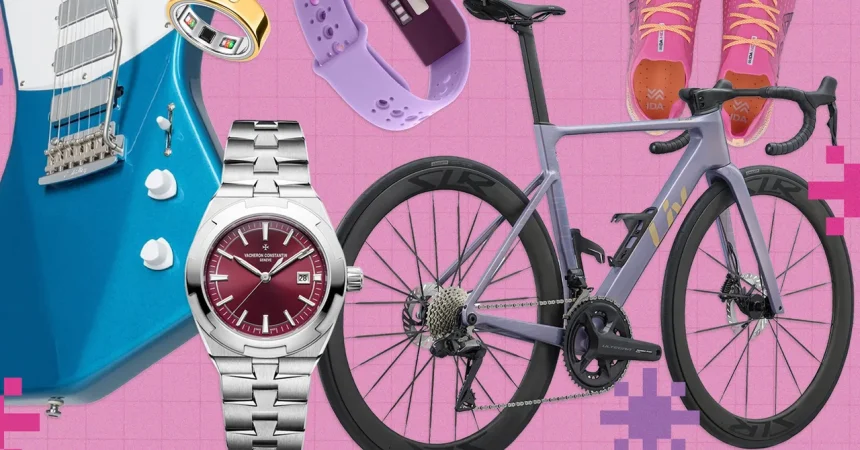
3. In the world of sports and performance, this principle is finally taking root. TaylorMade’s Kalea Gold driver was developed with Michelle Penney, a principal product-development engineer, leading the charge, with input from female employees, players, and a dedicated women’s advisory board. The lightweight 47-gram shaft and 11.5- or 13.5-degree lofts are designed to help women generate speed without sacrificing control—a far cry from merely altering a men’s club. Similarly, IDA Sports builds high-performance soccer boots from the ground up, informed by biometric data from professional women players. Cofounder Laura Youngson started the company after realizing how poorly existing boots fit women’s feet. The Helia Pro features a lightweight mesh upper, a Pebax soleplate, female-specific flex zones, and shorter, rounded cleats arranged in a unique pattern for firm ground and artificial turf. On the road, Liv was founded by Bonnie Tu, chair of the company behind Giant bikes, who herself struggled to find a bicycle that fit properly. Liv designs every frame size with its own geometry based on women’s biometric data, and the EnviLiv Advanced Pro is the flagship—an aero race bike with a carbon frame, wind-tunnel-tested handlebars, deep-section wheels, and SRAM Force AXS wireless shifting. But the key is that fit is treated as a complete system: stem length, handlebar width, crank length, and saddle are all chosen for the rider, not left as afterthoughts. Even workwear is getting the treatment. New Balance’s Fresh Foam Cremone safety shoe looks like a trail runner rather than a clodhopper, but it offers composite toe protection, an anti-perforation layer, heat resistance, and grip for oily floors, all while borrowing athletic foam cushioning to keep you comfortable on long shifts. These are not pinkwashed products; they are engineered interventions driven by female athletes and workers.
4. The intersection of health, technology, and self-care has become another fertile territory for women-led innovation. Natural Cycles, cofounded by CERN physicist Elina Berglund Scherwitzl—who helped discover the Higgs boson—makes the world’s first FDA-cleared birth-control app. Its screenless NC° Band is worn on the wrist while sleeping, tracking temperature, heart rate, and movement, then syncing to the app to deliver daily fertility guidance with an advertised 93 percent accuracy. A recent partnership with Whoop, the fitness wearable company, promises to further strengthen both brands’ offerings. Then there’s the Circular Smart Ring 3 Slim, a remarkably unobtrusive wearable at just 1.9 grams, which tracks sleep, heart rate, blood oxygen, skin temperature, and heart-rate variability. The slimmer profile makes it look like jewelry, and it now adds NFC for contactless payments and vibration alarms. For those needing more medical insight, the larger Ring 3 Pro includes FDA-cleared ECG sensors to detect atrial fibrillation. On the domestic front, Dreame’s Miracle Pro hair dryer uses artificial intelligence to adjust temperature, heat, and airflow automatically, monitoring conditions 1,000 times per second. It also features an essence atomizer for conditioning and red light therapy for scalp health, with magnetic attachments that are automatically detected so the dryer adjusts its power and heat accordingly. These products are not just gadgets; they are expressions of a broader movement to put women in control of their own bodies, health, and daily routines, with technology that listens rather than dictates.
5. Beyond practical tools, there is a flourishing world of creativity and making, where women are both designing and teaching others to build. Adafruit, founded by Limor Fried—the first female engineer to appear on the cover of WIRED—has grown into a 100-percent woman-owned force in open-source electronics. Fried, whose nickname Ladyada honors computing pioneer Ada Lovelace, has spent years lowering the barrier to coding and hardware hacking. The company’s range includes beginner-friendly boards, wearable controllers, touchscreens, and a programmable e-paper name badge, the Pimoroni Badgeware Badger, that lets you wear your code on your sleeve. Similarly, KiwiCo was founded by chemical engineer and mother-of-three Sandra Oh Lin to make hands-on science and engineering projects accessible and enjoyable at home. Ranging from simple sensory play for babies to animatronics, marble roller coasters, and working desk lamps for teens and adults, the kits arrive with all necessary components and clear explanations. In the world of music, Annie Clark—better known as art-rocker St. Vincent—designed her Ernie Ball Music Man signature guitar with an unusual blend of midcentury retro-futurism and the sharp triangular silhouettes of avant-garde performer Klaus Nomi. She spent 20 prototypes perfecting the weight, balance, and feel, shaping a heavily beveled body with a narrow waist that sits comfortably against a woman’s torso. The guitar, built from lightweight okoume wood and roasted maple, weighs around 7.5 pounds and features three custom DiMarzio mini-humbuckers controlled by a five-way selector. Even luxury watchmaking is recalibrating its approach: Vacheron Constantin’s Overseas Self-Winding comes in at 34.5mm, a near-exact downsize of the 41mm model, with nothing lost except the outer seconds track. In stainless steel or pink gold, it suits both men and women, with quick-release straps, a sapphire caseback, and a 40-hour power reserve—proof that serious horology can be refined and inclusive rather than oversized and exclusive.
6. Together, these stories paint a vivid picture of a design revolution that is neither niche nor accidental. From Tisha Johnson reshaping the American pickup to Bonnie Tu reimagining the bicycle, from Laura Youngson rebuilding the soccer boot around women’s feet to Michelle Penney engineering a golf club for women’s swing dynamics, the common thread is a refusal to accept “shrink it and pink it” as a solution. Instead, these women are leading with data, personal experience, and a deep sense of what it means to live, work, play, and move in a female body. They are also humanizing the products themselves, making objects that feel like companions rather than tools, that acknowledge complexity and difference, and that invite care and connection. The result is not just a better product but a better standard: one that values perception over power, comfort over convention, and authenticity over artifice. Whether it’s a £25,000 EV that wants to be loved, a saddle printed to your exact posterior, or a hair dryer that thinks about your scalp, the message is clear. When women are at the design table, they don’t just design for women—they design for everyone. And the world is better for it. These 16 innovations, each remarkable in its own right, collectively represent something larger: the quiet, steady reshaping of our material culture by women who know that true design is the ultimate act of empathy.