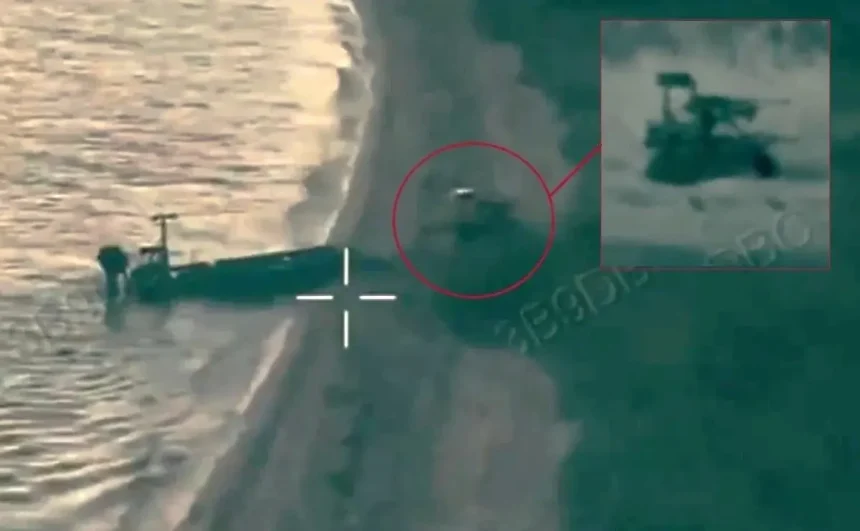
On July 13th, a quiet revolution took place on the shores of the Kinburn Spit, an area steeped in the history of centuries-old conflict. A video released by Ukrainian forces showed a small, uncrewed boat beaching itself, lowering a ramp, and deploying a tracked, remote-controlled robot. Once on the sand, the machine opened fire with a mounted machine gun, marking what Ukrainian officials believe is the world’s first combat mission executed by a robot delivered to enemy territory by an unmanned maritime vessel. While a single robot on a beach may seem modest, it represents a monumental shift in military strategy. In a war already defined by unprecedented drone innovation—from the sinking of warships to the first aerial dogfights—this “marsupial” transport of a ground robot via boat suggests we are entering an age where machines lead the vanguard of amphibious warfare.
The Kinburn Spit itself is a strategic prize, a lush, 25-mile-long peninsula that controls the entrance to the Dnipro–Bug estuary. It has been a thorn in Ukraine’s side since Russian forces occupied it in June 2022, effectively turning it into a base for artillery and sensor operations that threaten the ports of Mykolaiv and Kherson. Historically, retaking such a fortified, isolated position would invite catastrophic casualties, much like the Allied landings at D-Day. However, the introduction of robotics fundamentally alters this grim calculation. By replacing human marines with expendable machines, the Ukrainian military is testing a paradigm where the risk of loss is shifted from the soldier’s life to a piece of hardware that costs roughly $30,000—a negligible price compared to the lives of trained infantry.
Ukraine’s industrial scale-up of these Uncrewed Ground Vehicles (UGVs) is staggering. With plans to produce 50,000 units by 2026, the military is rapidly integrating these machines into frontline combat. Small, quad-bike-sized units equipped with high-caliber turrets are already proving their worth. Commanders have reported instances where a single robotic unit maintained a frontline position for 45 days, fighting off adversaries solo while returning only to recharge and reload. The vision held by some Ukrainian commanders is bold: to replace nearly a third of front-line infantry with these robotic counterparts by the year’s end, transforming the human role from that of a combatant to that of a remote operator overseeing a fleet of smart platforms.
Success in these operations, however, does not mean the robots act in a vacuum. In fact, they are the centerpieces of a “remote combined arms” dance. A single mission typically involves a sophisticated network of technologies: scout drones map the terrain to prevent the UGV from flipping on rough ground, while overhead FPV (first-person view) drones provide precision strike capabilities. When a UGV advances, it acts as a lure, forcing opposing troops to fire and effectively reveal their hidden positions. Once the enemy’s location is unmasked, the surrounding drone swarm neutralizes the threat. Robots may be the ones pulling the trigger, but their effectiveness is tied to the constant, real-time intelligence feeds provided by their human handlers miles away.
The “marsupial” approach—using one autonomous platform to ferry another—is rapidly evolving as a solution to the range and logistics bottlenecks of modern warfare. Just as the U.S. Navy experimented with similar concepts, Ukraine is deploying an vast, versatile fleet of unmanned surface vessels to act as mobile launchpads. This modularity allows for “soft” landings: rather than risking a landing craft packed with soldiers, the military can probe defenses or harass enemy positions with virtually no risk to human life. If a robot hits a landmine or enters a booby-trapped site, the mission is stalled rather than ruined, the equipment is written off as an acceptable cost, and the operators remain safely distanced from the heat of battle.
Looking ahead, the implications of the Kinburn Spit mission are clear: the nature of the traditional amphibious assault is being rewritten. We have likely witnessed the nascent stage of a future where every storming of a beach is led by a robotic spearhead. In this vision of war, the human presence is deferred, arriving only after machines have neutralized the opposition and secured a safety perimeter. While the moral and strategic complexities of this transition are vast, the logistical reality is undeniable. Warfare is increasingly becoming an exchange of hardware rather than a collision of lives, marking a technological “giant leap” that will fundamentally change how nations contend for territory in the years to come.