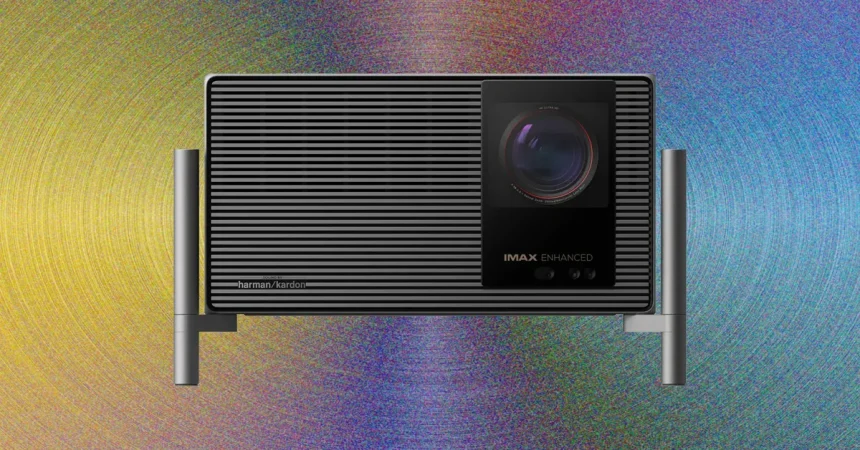
When you set out to truly push a projector to its limits, the first thing you look for is the “deep black” threshold. To test the Titan Noir Max, I dove deep into its settings—tinkering with noise reduction, sharpness, and the DBLE feature—to see how it handled the heavy lifting of high-contrast cinema. There is perhaps no better litmus test for this than the early-morning sequences in The Creator. Most projectors, even supposedly high-end models, inevitably cave here, turning those moody, shadowed landscapes into a muddy, washed-out mess. Yet, the Titan managed to render those dark grays and blacks with a cinematic richness that felt incredibly grounded. By leveraging its dynamic iris and DBLE technology, the projector navigated the tension between light and shadow with an elegance that made the film feel brand new.
However, no piece of technology is perfect in every single category, and the Titan Noir Max is no exception. When I pitted it against the Epson ProCinema LS9000 using Avatar: Fire and Ash, the differences became clearer. The Epson, bolstered by its superior high-end lens optics, possesses a surgical sharpness that keeps the entire image in perfect focus from corner to corner. While the Titan looked absolutely gorgeous—offering vibrant, punchy colors during the sunny, oceanic scenes—it couldn’t quite match the sheer pixel-perfect resolution of the LS9000. It performs on par with the Leica Cine Play 1 in terms of saturation and color pop, but for the purist who demands absolute micro-detail, there is still a small gap to bridge between the Titan and the industry’s most expensive laser lenses.
The real challenge for any projector, of course, is the “living room test.” We all want that big-screen experience, but we don’t all live in pitch-black, dedicated home theaters. In a brightly lit room, many projectors—the Leica Cine Play 1 included—just give up, leaving the screen looking like a foggy gray square. The Titan Noir Max held its own surprisingly well during the daylight battle scenes of War Machine, maintaining a surprising amount of color integrity that kept the experience engaging despite the ambient light. That said, physics is an unforgiving mistress; when I queued up darker, moodier films like Awake, the sunny room environment took its toll. While the picture was crisp and spectacular in a light-controlled environment, you simply have to accept that a brightly lit room will dim the intensity of any projector’s shadows.
Once I moved into the world of gaming, the Titan really proved its worth. Playing 007: First Light on the Xbox at a 120-inch projection was a sensory experience that felt genuinely “next-gen.” The colors were eye-poppingly vibrant, and the sense of scale was immense—which is good, considering this unit can push an image up to 300 inches. I didn’t try projecting on the garage door, if only because at 18 pounds, the Titan isn’t exactly something you’d want to lug around for a backyard movie night; it’s a machine designed to be installed and kept in its place. Still, for a gaming setup, it offers an immersive quality that makes standard monitors feel claustrophobic by comparison.
Part of what makes the Titan so reactive during fast-paced gaming is the speed of its dynamic iris, which shifts rapidly to match the tonal density of the onscreen action. As I played through First Light, shifting between brilliant sunlight and the sudden, creeping shadows of a nighttime misty segment, the projector constantly adjusted its brightness on the fly. It is a seamless process, though there is a small nuance: if you keep the room completely silent, you can hear a faint mechanical click as the iris recalibrates. It’s a sound I actually found endearing—a reminder of the precision engineering happening inside the box—but if you’re a user who demands absolute silence, just know it’s there, even if it’s instantly buried by any loud, chaotic movie or game audio.
Ultimately, the Titan Noir Max lands in a very interesting space in the market: it offers premium, “wow-factor” visuals that handle difficult lighting conditions better than most, while providing a gaming experience that feels expansive and alive. It isn’t the sharpest instrument in the shed compared to the top-tier, ultra-expensive cinema lenses of the world, and it isn’t a portable toy you’ll carry from room to room. But as a centerpiece for a home media room, it hits a high bar. It balances the complexities of deep blacks and dynamic lighting with a grace that makes you want to keep clicking “play” just to see what it will render next. It’s a sophisticated machine for those who want their home screen to feel like a portal rather than just a display.