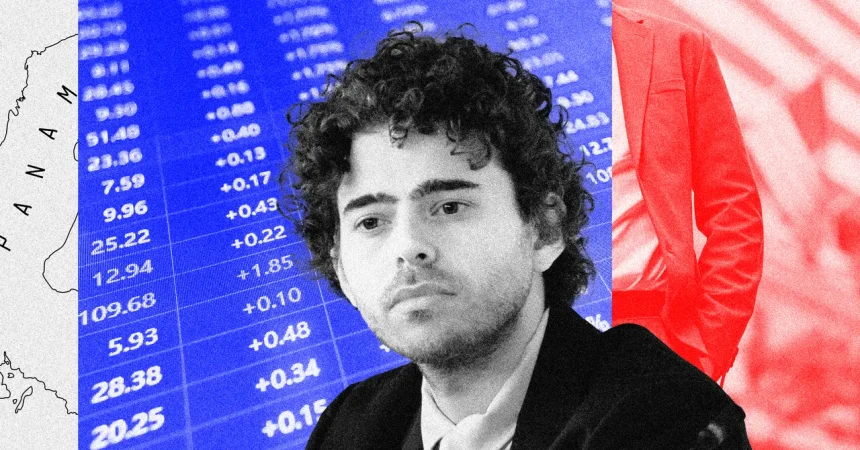
The story of Polymarket is one of those modern-day sagas that feels stranger than fiction. When you look at the headlines surrounding the prediction market, it reads like a thriller—there are FBI agents using battering rams to raid the CEO’s apartment, allegations of insider trading involving special forces soldiers and tech veterans, and whispers of executives paying influencers through personal accounts to stir up hype. Yet, beneath the chaotic news cycle, a more technical but equally suspicious mystery has been hiding in plain sight: the company’s elaborate, paper-thin corporate structure in Panama. While Polymarket paints itself as a global platform, its struggle to comply with U.S. federal law reveals a company that seems to have confused “compliance” with “theatrical misdirection.”
To understand how we arrived here, we have to travel back to 2022, when the Commodity Futures Trading Commission (CFTC) caught up with the platform. Federal regulators slapped Polymarket with a $1.4 million fine, accusing it of operating as an unlicensed derivatives exchange and effectively banishing it from the U.S. market. To stay afloat, the company orchestrated a complex shell game: they established “Adventure One QSS,” an offshore entity based in Panama, ostensibly to ring-fence the platform’s operations away from U.S. soil. The narrative was simple enough on paper—if the platform existed in Panama, it could theoretically operate outside the jurisdiction of American regulators. But as recent investigations suggest, this was less of a legitimate international business strategy and more of a ghost town masquerading as a corporate headquarters.
When journalists started poking around, the cracks in the facade were impossible to ignore. Reporters from both WIRED and NPR found that the supposed Panamanian nerve center was nothing more than an empty, lifeless office space in a Panama City skyscraper. The locals listed on incorporation papers to provide the company with a veneer of legitimacy—mostly lawyers and administrative placeholders—seemed to have no real connection to the daily grind of the business. Even more telling is what former employees have shared: there were effectively no colleagues in Panama to begin with. The offshore entity existed as a legal filing, not as a functional workplace, leaving one to wonder if the company ever intended to operate from there at all.
Perhaps the most damning aspect of this arrangement is the revelation that the people supposedly running the “Panamanian” ship were actually sitting in Manhattan. Despite the legal firewall meant to separate American operations from the offshore platform, witnesses report that staff technically employed by Adventure One QSS were working side-by-side with New York-based colleagues. These employees weren’t hopping flights to Central America or reporting to local supervisors; they were coding, managing event contracts, and navigating the platform from the very city that federal regulators had explicitly told them to avoid. In practice, the wall between the “onshore” and “offshore” arms didn’t exist; it was the same team, the same desks, and the same office culture, all under a different corporate header.
For former regulators, this isn’t just a quirky detail—it’s a direct insult to the settlement process. One former CFTC lawyer expressed clear frustration, noting that the agency assumed they were dealing with an offshore entity when, in reality, they were looking at a domestic operation wearing a costume. When the government orders a company to “wind down” illegal market activities and relocate operations, they expect a genuine separation of boundaries. By keeping the staff in New York while claiming the work was being done in Panama, Polymarket essentially circumvented the intent of the law. It suggests a philosophy of compliance that prioritizes optics over reality, effectively treating a federal order like a hurdle to be jumped with a clever legal loophole rather than a rule to be followed.
Ultimately, these revelations highlight the “move fast and break things” mentality that has permeated much of the crypto-adjacent tech world. By building a convoluted legal structure that lacked any real substance, Polymarket created a situation where they were one federal investigation away from total collapse. Whether it was the FBI raids or the scrutiny over their corporate residency, the company has consistently found itself on the defensive. When you build a business model on the edges of legality, the paperwork becomes your only shield. But in this case, the shield was made of glass. The company’s inability to maintain a transparent, honest organizational structure seems to be their own undoing, proving that even in the high-stakes world of prediction markets, you still can’t outrun the truth.