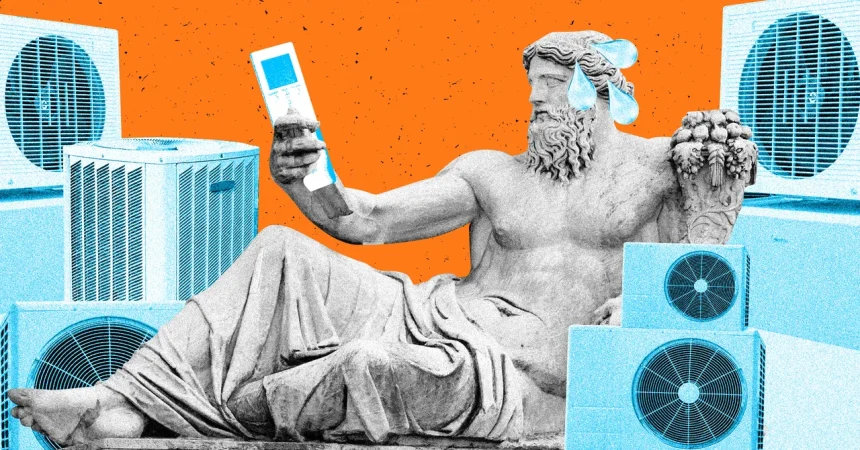
As record-breaking heat waves push temperatures across Europe into dangerous territory, the annual struggle to stay cool has transformed from a minor inconvenience into a pressing societal crisis. When summer arrives, we find ourselves retreating behind drawn blinds, desperate for relief as our homes turn into literal ovens. Recent scenes of frantic shoppers storming stores to clear out portable fans and air conditioning units across France aren’t just isolated incidents; they are harbingers of a “new normal.” With the International Energy Agency predicting that two-thirds of the world’s households could rely on AC by 2050, the debate over how we regulate our indoor climate is quickly becoming one of the defining challenges of the century.
The conversation around cooling has unfortunately become inseparable from the polarized landscape of modern politics. While some politicians treat air conditioning as a populist trophy—promising universal access as a remedy for heat-induced misery—others view it through a lens of equity, warning that widespread adoption will only deepen the divide between the wealthy and the vulnerable. Currently, while nearly 90 percent of U.S. homes are cooled, only about one-fifth of European households have access to the technology. This massive disparity highlights a mounting tension: as Europe warms faster than any other continent, the drive to install ACs is pitting the immediate, life-saving need for comfort against the long-term anxieties of energy consumption and environmental sustainability.
Beyond the political posturing, there is a very human cost to our failure to adapt to rising temperatures. Air conditioning is no longer just a luxury; it is a vital tool for survival. When the air stays stiflingly hot well past sunset, it isn’t just a matter of discomfort—it’s a threat to physical health, child development, and basic productivity. Research suggests that in 2019 alone, air conditioning was responsible for preventing nearly 200,000 premature deaths among the elderly. As we look at data from experts at the University of Oxford, it’s clear that countries like the UK, Finland, and Switzerland are facing the steepest curves in cooling demand. We are finding that even our most “resilient” architecture—from thick stone southern villas to modern northern apartments—is failing to hold up against the intensity of modern climate extremes.
The real dilemma, however, is that our primary solution to the heat is actively contributing to the very problem that caused it. We are caught in a feedback loop: the machines we use to stay cool are powerful drivers of global greenhouse gas emissions, currently accounting for roughly 3 percent of the global total. As energy grids struggle to keep up with the surge in demand—a surge that could triple by 2050—industry analysts are sounding the alarm. Relying on inefficient, panic-bought portable units is essentially a recipe for environmental disaster. We are not just cooling our rooms; we are displacing heat into our streets and pumping carbon into our atmosphere, creating a cycle that makes the outdoors even more dangerous for those without access to technology.
The technology itself faces a significant reckoning beyond just energy usage. Most modern air conditioners still rely on centuries-old refrigerant technology that uses fluorinated gases—substances with a global warming potential thousands of times greater than carbon dioxide when they leak. Although the European Union is moving toward a strict phase-out of these harmful chemicals by 2024, the path forward is far from straightforward. The natural alternatives, such as propane or ammonia, bring their own significant risks, including flammability and toxicity. This forces us to confront the fact that cooling isn’t just an electrical engineering problem; it is a delicate safety and environmental balancing act that we have yet to master.
Ultimately, the goal is not to abandon air conditioning, but to fundamentally rethink how we exist within our changing landscapes. Experts maintain that we need a “smart” approach—one that prioritizes building efficiency, natural cooling, and equitable distribution over the haphazard installation of energy-hungry units. We have reached a point where passive strategies, such as retrofitting buildings and improving ventilation, must take center stage alongside necessary mechanical aid. Protecting the population from the encroaching heat is a moral imperative, but we must be careful to ensure that the tools we choose to save ourselves today don’t leave us in an even more precarious position tomorrow.