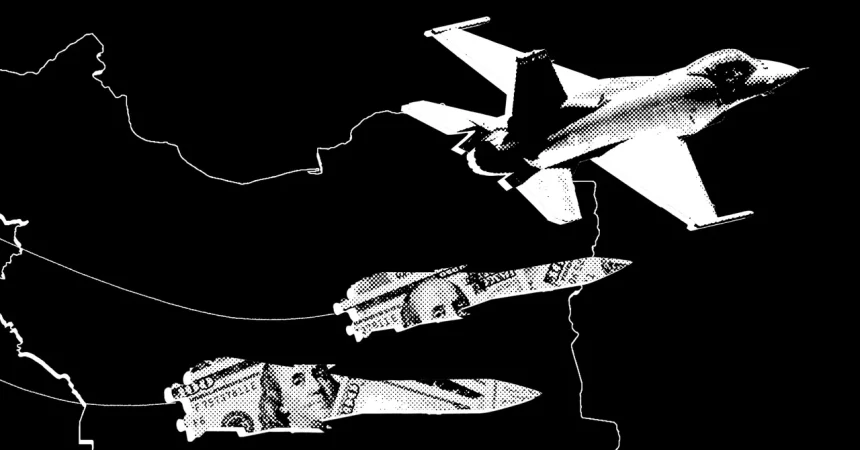
The recent escalation between the United States and Iran, marked by a series of intense missile strikes, has quietly spiraled into a financial behemoth that is beginning to strain the Pentagon’s resources. While headline news often focuses on the tactical shifts on the ground, behind the scenes, intelligence officials and congressional analysts are grappling with a staggering price tag. Estimates suggest the total cost for “Operation Epic Fury” has already soared past $80 billion, with some projections reaching as high as $100 billion. Despite the sheer scale of this expenditure, the Trump administration has remained vague, offering only conservative, piecemeal requests for funding that seem to intentionally obscure the true economic impact of this ongoing confrontation.
What makes this financial picture particularly murky is the Pentagon’s calculated approach to what it chooses to disclose—and what it chooses to leave out. Defense officials are currently engaged in a complex debate over whether or not to replace the significant number of aircraft decimated in the conflict. By choosing not to request new funding for lost assets, the administration effectively shrinks the public price tag of the war, masking the true operational cost. When pressed, the War Department has offered little more than standard boilerplate responses, refusing to confirm the mounting figures or provide clarity to the public. Behind closed doors, however, the reality is far more expensive than the $29 billion figure previously touted by officials, which conveniently ignores the massive costs of equipment depreciation and logistical overreach.
The physical toll of the conflict is perhaps best illustrated by the loss of hardware, much of which is prohibitively expensive to build or repair. According to the Congressional Research Service, the U.S. has lost at least 17 manned aircraft and 25 drones since the fighting began. Among these losses is the MQ-4C Triton, a high-altitude surveillance titan with a price tag of over $600 million per unit. These aren’t just line items on a balance sheet; they represent a significant depletion of U.S. air superiority. Furthermore, the repairs needed for regional bases damaged by Iranian retaliatory strikes—some of which are so vulnerable they may face permanent closure—add another layer of financial instability that the government is choosing to ignore rather than address or account for.
Adding to the complexity is the vulnerability of critical infrastructure to direct Iranian retaliation. Reports indicate that U.S. facilities, including elements of the Fifth Fleet in Bahrain, have suffered damage that the Pentagon has been hesitant to acknowledge publicly. This reluctance to admit the severity of Iranian counter-strikes is as much about managing political optics as it is about national security. By failing to disclose the true extent of the damage to these key Middle Eastern bases, the administration maintains a facade of control, even while defense planners realize that keeping these sites operational could prove either too costly or too risky to sustain in the long term.
While the kinetic war rages in the Middle East, the administration is simultaneously pivoting to a new, invisible theater of conflict: the digital realm. On Tuesday, the White House introduced “Operation Gold Eagle,” a clearinghouse designed to identify and seal software vulnerabilities before they can be exploited by the increasingly sophisticated AI models utilized by malicious actors. Managed by the Cybersecurity and Infrastructure Security Agency, this initiative represents the first major push to implement President Trump’s recent executive order on AI. It acknowledges a sobering reality: in modern warfare, a line of malicious code can be just as dangerous—and just as costly—as a missile strike.
Ultimately, these two stories—the rising billions spent on a kinetic war in the desert and the high-tech scramble to secure our digital borders—paint a portrait of a government stretched thin by the demands of a volatile global landscape. We are living through a period where the traditional costs of war are being obscured by executive silence, while the new era of technological instability requires us to invest billions more into defenses we can’t even see. As the figures continue to climb past $100 billion and the definition of a “battlefield” expands into the lines of AI code, the American public is left with a difficult question regarding transparency: how much can a nation afford to spend on a conflict that its government is determined to keep in the shadows?