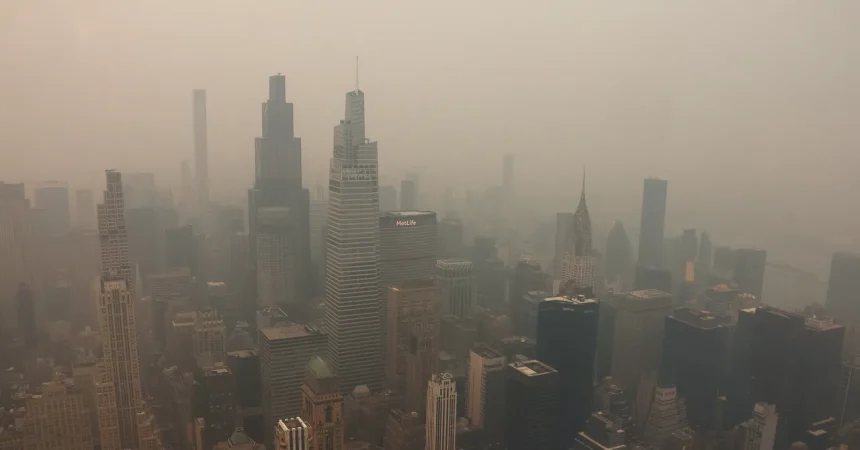
As the world turns its gaze toward New York this Sunday for the ultimate clash between Argentina and Spain, the anticipation is being tempered by an unexpected opponent: the thick, hazardous smoke currently drifting down from Canadian wildfires. While the stage is set for a historic showdown between icons like Lionel Messi and Lamine Yamal, the atmosphere outside the stadium has become a pressing public health concern. Residents throughout the region have watched the horizon turn an ominous, hazy orange, as air quality levels flirt with “very unhealthy” ratings. City officials have issued stark warnings, urging citizens to stay indoors to avoid the noxious smog—a direct contradiction to the spectacle of a global sporting event meant to be enjoyed under the open sky.
The stark reality is that the stadium, which will host thousands of fans and some of the world’s most elite athletes, is an open-air venue with no mechanism to filter the air or protect those inside. For the players, the physical demand of a professional soccer match involves intense cardiovascular output, meaning they are essentially functioning as high-performance air filters, drawing massive volumes of particulate-laden air deep into their lungs. Medical experts are sounding the alarm, noting that even if the air quality index improves slightly by kickoff, the baseline health risk for sensitive groups—including children, seniors, and those with respiratory issues—remains significant. Seeing teams practice outdoors in these conditions has reignited a debate regarding who, exactly, is prioritizing the health of these individuals over the continuity of the game.
Perhaps the most troubling aspect of this situation is the apparent vacuum of leadership from FIFA, the sport’s governing body. While FIFA has made headlines for its robust protocols regarding extreme heat—including mandatory water breaks—it seems to have ignored the encroaching reality of climate-related air pollution. Despite inquiries and the clear visibility of environmental hazards, FIFA has offered no specific contingency plans for the smoke. While they claim to coordinate with local authorities on climate risks, their lack of a transparent policy for air quality stands in sharp contrast to the proactive stances taken by other major organizations, such as the National Women’s Soccer League (NWSL) or Major League Baseball, which have already begun canceling or postponing events to ensure safety.
It is difficult to ignore the pattern of organizations relying on “luck” rather than rigorous preparation. FIFA’s gamble that the air would remain clear has certainly paid off for the majority of this tournament, but relying on the whims of wind patterns is not a sustainable or responsible management strategy. Academics and industry experts note that while FIFA will likely “dodge a bullet” if the smoke clears by Sunday, this near-miss does not insulate them from the criticism that they are fundamentally unprepared for a warming world. The climate crisis is no longer a distant theoretical threat; it is an active variable that affects the feasibility of outdoor athletic events, and treating it as an outlier rather than a standard operational risk is a dangerous oversight.
This conversation also forces a broader reckoning within the world of professional sports. Athletes like Trinity Rodman have voiced a sentiment that many are beginning to share: if environmental conditions are so severe that we must force hydration breaks every fifteen minutes just to make the game playable, perhaps the game shouldn’t be played at all. The drive to protect the integrity of the tournament schedule often clashes with the ethical responsibility to protect the people competing on the field. When the air is thick with hazardous pollutants, the “show must go on” mentality starts to look less like sportsmanship and more like negligence, effectively turning athletes and fans into collateral damage for the sake of a broadcast.
Ultimately, the match between Argentina and Spain serves as a microcosm for our global struggle to adapt to a changing climate. As FIFA and other organizations navigate a future of more frequent wildfires, extreme temperatures, and volatile environmental conditions, they must evolve their definition of “preparedness.” Being able to host a game is a privilege that depends entirely on a safe environment; once that environment becomes toxic, the sport loses its foundation. Whether or not Sunday’s final proceeds without incident, the conversation regarding FIFA’s lack of a clear, actionable plan for air quality is one that can no longer be ignored, lest the beautiful game find itself sidelined by the very environment it relies upon.