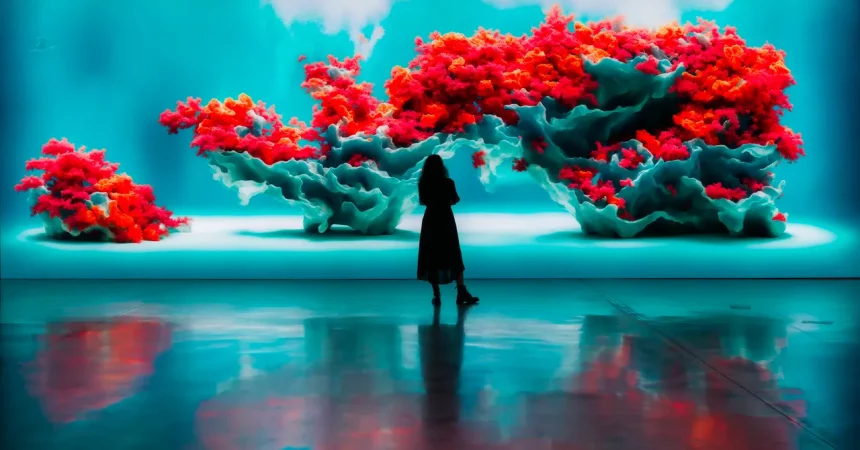
We find ourselves standing at the precipice of a new cultural epoch, a period that the visionary artist Refik Anadol boldly describes as a true “renaissance.” While the rapid ascent of artificial intelligence in the creative sphere has sparked fierce debate and widespread skepticism, Anadol views this tension not as an end, but as a beginning. He argues that we are currently living through a transformation so profound that we lack the vocabulary to define it. His perspective is a breath of fresh air in a landscape often clouded by cynicism, suggesting that instead of fearing the machine, we are witnessing the birth of a brand-new way to experience humanity. By leaning into the synergy between human intuition and algorithmic precision, Anadol is attempting to prove that technology can be a canvas for grace rather than just a tool for automation.
This philosophy found a physical home earlier this summer with the opening of Dataland in downtown Los Angeles. Co-founded by Anadol and his creative partner Efsun Erkılıç, this space is billed as the world’s first-ever museum dedicated to the art of artificial intelligence. The public response has been nothing short of staggering; in just its first two weeks, the gallery drew over 10,000 visitors. This immense turnout suggests a deep, underlying hunger among the public to see whether AI can offer something more meaningful than the sterile, algorithmically generated content that has flooded our social media feeds. Dataland isn’t just a gallery; it is a proof-of-concept for a future where technology is curated, felt, and humanized.
At the heart of the museum lies Machine Dreams: Rainforest, a sensory masterpiece that serves as the centerpiece for this new era. This isn’t a static exhibit you simply look at; it is a living, breathing architectural environment that listens and reacts. By utilizing wearable technology, the exhibit tracks the biometric data and movements of its audience, folding that information into the digital ecosystem in real time. The resulting audiovisual landscapes are birthed from Anadol’s “Large Nature Model,” a sophisticated system built upon environmental data pulled from archives like the Smithsonian. It is a brilliant marriage of data science and natural wonder, turning cold numbers into the lush, shifting textures of a living forest.
The backbone of this project is a commitment to data integrity that stands in stark contrast to the way many major tech firms operate. Anadol spent three years building his models from the ground up, moving away from the controversial industry practice of “scraping”—the mass-harvesting of existing online content without creator consent. By venturing into the Amazon to collect original raw materials and partnering with researchers for their proprietary datasets, he has amassed five petabytes of information gathered with ethics and permission at the forefront. This approach serves as a quiet rebuke to the “extractive” models often criticized by artists, proving that one can pursue innovation without sacrificing the rights and dignity of other creators.
Furthermore, Anadol is tackling the thorny issue of environmental impact with a level of transparency rarely seen in the tech sector. Recognizing that massive computing power often comes with a significant carbon footprint, his collaboration with Google DeepMind has allowed Dataland to utilize “experimental low-energy” resources. By leveraging Google Cloud to maintain sustainable compute, the project aims to demonstrate that digital art does not have to come at the expense of the planet. This level of foresight is vital; if artificial intelligence is to be accepted as a valid medium for high art, it must demonstrate a commitment to sustainability, ensuring that the legacy of a digital creation is measured in beauty rather than waste.
Ultimately, Anadol acknowledges that the term “AI art” has become a tainted brand, often associated with low-quality, prompt-engineered content or fleeting viral clips. He doesn’t dismiss these valid criticisms; rather, he embraces them as a challenge to raise the bar. By fostering an environment where technology serves the artist’s vision rather than distracting from it, Dataland is working to reclaim the narrative. Anadol wants visitors to walk away feeling they haven’t just seen a program run a simulation, but rather a reflection of the world through a machine’s eyes—an encounter that is deeply human precisely because of the immense care and intellect poured into every pixel.